
Couples counseling works better when the two of you practice something concrete between sessions, not just "communicate more." This guide ranks six communication exercises used in evidence-based couples counseling in 2026, tells you what conflict pattern each one fixes, and flags which ones need a therapist in the room versus which you can practice at your kitchen table tonight.
- The Speaker-Listener Technique is the best overall pick among communication exercises for couples counseling in 2026.
- Time-outs paired with physiological self-soothing work best once an argument starts to feel out of control.
- The Weekly State-of-the-Union check-in keeps small friction from building into resentment between sessions.
- The Dream-Within-Conflict dialogue handles recurring, stuck arguments best with a couples counselor guiding it.
Why this matters
Most couples don't lack love or effort. They lack a repeatable format for hard conversations, so every disagreement starts from zero. A structured exercise gives both partners a role, a sequence, and a stopping point — which lowers the odds that a fifteen-minute disagreement turns into a three-hour standoff.
Havencrest Wellness & Counseling works with couples throughout Washington, in person and via telehealth, and these exercises reflect patterns that show up across that work: escalation, withdrawal, and the sense of "we keep having the same fight." None of them replace a course of couples counseling — they give you something to practice between sessions.
What makes the best communication exercise for couples
- Evidence base — rooted in established approaches like the Gottman Method, Emotionally Focused Therapy, or CBT-informed communication skills
- Practicable outside session — partners can rehearse it at home without a clinician present
- Targets a specific pattern — escalation, criticism, withdrawal, or disconnection, not "communication" in general
- Works for both partners' styles — doesn't favor the more verbal or more confident person in the room
- Requires no special equipment — a timer or a notecard is the most it asks for
- Scales with severity — usable for daily friction and, with guidance, for entrenched conflict
Communication exercises for couples counseling at a glance
| Exercise | Best For | Standout Feature | Key Limitation |
|---|---|---|---|
| Speaker-Listener Technique | Structured conflict conversations | Turn-based roles prevent interruption | Feels scripted the first few tries |
| Time-Outs & Physiological Self-Soothing | De-escalating flooding | Built-in pause before emotion takes over | Both partners must agree to actually stop |
| "I" Statements | Day-to-day friction | Reduces blame language automatically | Easy to disguise criticism inside the format |
| Weekly State-of-the-Union Check-In | Staying connected between sessions | Dedicated non-crisis time to talk | Only works with consistent scheduling |
| Appreciation & Gratitude Exercise | Rebuilding positive sentiment | Directly counters negative sentiment override | Can feel forced if resentment runs deep |
| Dream-Within-Conflict Dialogue | Recurring, gridlocked arguments | Surfaces the meaning behind a rigid position | Works best with a therapist facilitating |
1. Speaker-Listener Technique: best for structured conflict conversations
One partner speaks in short segments while holding a designated object — a pen, a coaster, anything — and the other partner reflects back what they heard before responding. The roles then switch. It's used widely in Gottman Method couples counseling because it physically blocks interruption and cross-talk.

Speaker-Listener Technique pros:
- Prevents both partners from talking over each other
- Forces active listening instead of rehearsing a rebuttal
- Works for topics ranging from finances to in-laws
Speaker-Listener Technique cons:
- Feels stiff and unnatural for the first several attempts
- Doesn't work mid-flood, when emotions are already too high to follow structure
Best for: couples who interrupt each other or escalate quickly during disagreements. Verdict: start here.
2. Time-Outs & Physiological Self-Soothing: best for de-escalating flooding
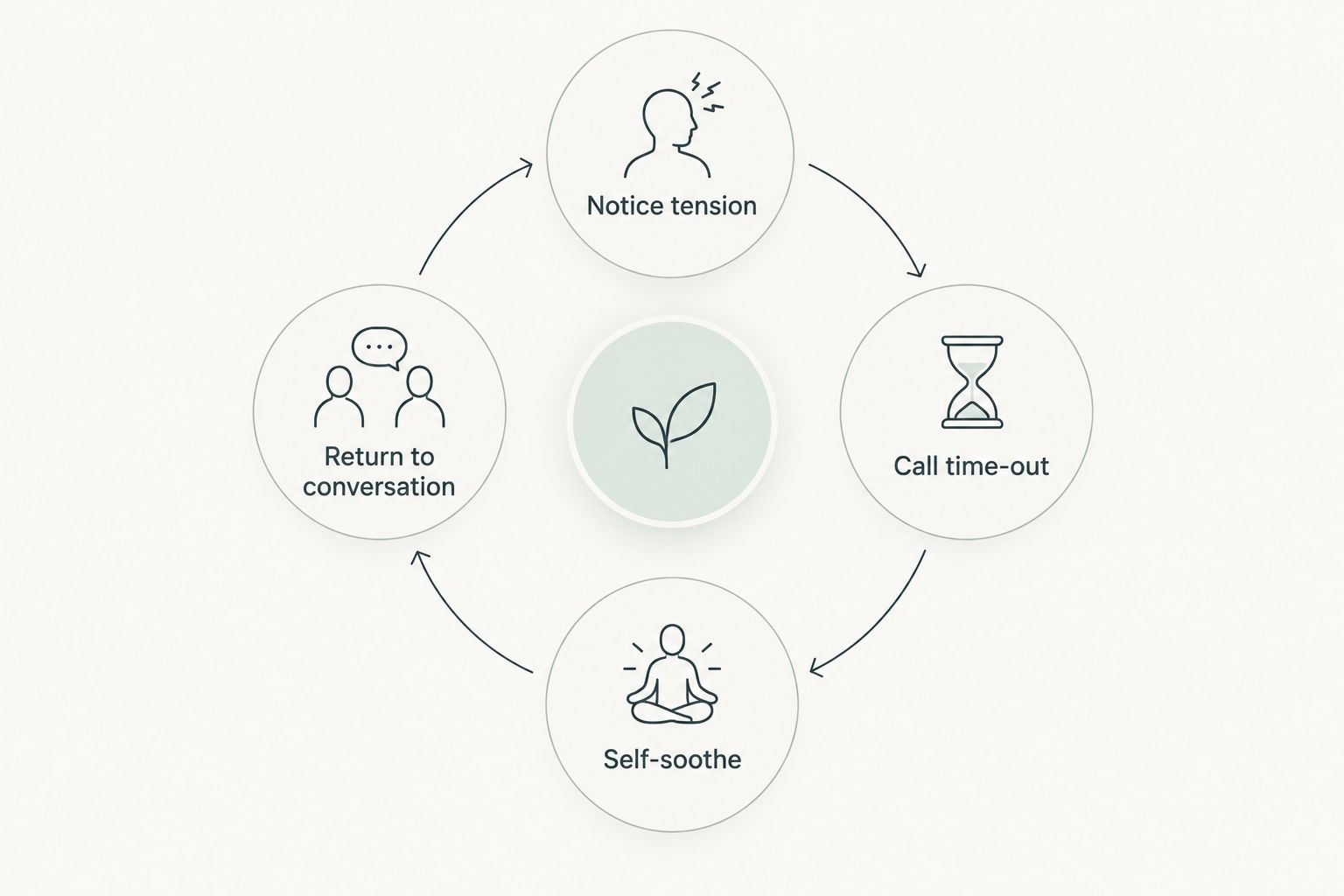
When either partner notices their heart rate spike or their thoughts narrow to attack-or-withdraw, either one can call a time-out — a pause with a stated return time, not a walkout. Each partner then does something calming alone: a walk, breathing, music. Research on emotional flooding suggests the body needs roughly 20 minutes to physiologically settle once it's activated, which is why a quick "let's talk it out" often backfires.
Time-Outs pros:
- Interrupts a fight before it says something that's hard to walk back
- Gives the nervous system time to actually calm down
- Easy to explain to both partners in one sentence
Time-Outs cons:
- Only works if both partners agree in advance to honor the pause
- Can be misused to avoid hard topics indefinitely if there's no set return time
Best for: couples where arguments escalate fast and one or both partners shut down or raise their voice. Verdict: pair with a stated return time, always.
3. "I" Statements: best for day-to-day friction
Instead of "you never help with the kids," the format is "I feel overwhelmed when I'm handling bedtime alone." It swaps accusation for a stated feeling plus a specific situation, which lowers the odds the other partner gets defensive before the sentence even finishes.
"I" Statements pros:
- Simple enough to use in the moment, no prep required
- Reduces blame language that triggers defensiveness
- Works well for small, recurring irritations
"I" Statements cons:
- Can become disguised criticism ("I feel like you're lazy" isn't really an "I" statement)
- Loses effectiveness once a fight is already heated
Best for: everyday complaints — chores, plans, small letdowns — before they build into a bigger argument. Verdict: use daily, low effort.
4. Weekly State-of-the-Union Check-In: best for staying connected between sessions
A scheduled 20 to 30 minute conversation, separate from any current conflict, where partners review what went well that week, what felt hard, and one thing to focus on next. It borrows from the Gottman Method's structured check-in and gives couples a non-crisis time to actually talk.
Weekly Check-In pros:
- Creates a predictable time to raise issues before they pile up
- Keeps the relationship conversation separate from the heat of an actual fight
- Reinforces that connection is maintained on purpose, not by accident
Weekly Check-In cons:
- Requires consistent scheduling — skipping weeks undermines the habit
- Doesn't address an active, unresolved conflict on its own
Best for: couples doing reasonably well who want to prevent small issues from becoming resentment. Verdict: schedule it like an appointment.
5. Appreciation & Gratitude Exercise: best for rebuilding positive sentiment
Each partner names one specific thing the other did that week that they appreciated — specific, not generic ("thank you for picking up dinner Tuesday," not "thanks for being great"). This directly targets what Gottman's research calls negative sentiment override, where partners start interpreting neutral actions as hostile.
Appreciation Exercise pros:
- Counters the tendency to only notice what's going wrong
- Takes under five minutes
- Works alongside almost any other exercise on this list
Appreciation Exercise cons:
- Can feel hollow or forced if resentment is already high
- Not a substitute for addressing the underlying conflict
Best for: couples whose day-to-day tone has turned critical or flat. Verdict: pair with the weekly check-in.
6. Dream-Within-Conflict Dialogue: best for recurring, gridlocked arguments
For the argument you've had a dozen times — the same topic, the same positions — this exercise asks each partner to explore what the rigid stance actually protects: a fear, a value, a childhood memory. It's drawn from Gottman's work on gridlocked conflict and it's the one exercise on this list that genuinely benefits from a therapist facilitating, since surfacing that material without support can reopen old wounds.
Dream-Within-Conflict pros:
- Gets past the surface argument to what it's really about
- Often explains why a "small" issue keeps recurring
- Builds understanding even when the underlying preference doesn't change
Dream-Within-Conflict cons:
- Not something to attempt cold, without guidance, on your hardest topic
- Slower than the other exercises here — it's not a quick fix
Best for: the argument that never actually resolves, just repeats. Verdict: bring it to a session, don't DIY it.
How we ranked these
Each exercise was ranked against the criteria above: does it target one specific conflict pattern, can most couples attempt it without a clinician present, and is it grounded in an established couples-therapy approach rather than general advice. Exercises that need a therapist's guidance are labeled that way rather than oversold as do-it-yourself fixes.
Which communication exercise should you choose?
If you're not sure where to start, start with the Speaker-Listener Technique — it's the most structured, the easiest to explain to a skeptical partner, and the one that catches the most common problem: talking over each other. Add time-outs if arguments tend to escalate, and layer in the weekly check-in once things stabilize. Save the Dream-Within-Conflict dialogue for a session with a couples counselor rather than attempting it alone on your most sensitive topic in 2026.
FAQ
What are the best communication exercises for couples counseling?
The Speaker-Listener Technique, time-outs with physiological self-soothing, and 'I' statements are among the most commonly used communication exercises for couples counseling in 2026. Each targets a different conflict pattern, from interruption to escalation.
Can couples practice these exercises without a therapist?
Most of them, yes — the Speaker-Listener Technique, 'I' statements, weekly check-ins, and appreciation exercises are designed for home practice. The Dream-Within-Conflict dialogue works best with a therapist facilitating.
How often should couples practice communication exercises?
Simple exercises like 'I' statements can be used daily as friction comes up. Structured ones like the weekly State-of-the-Union check-in work best on a set schedule, once a week.
What is the Speaker-Listener Technique in couples counseling?
It's a turn-based format where one partner speaks in short segments while the other reflects back what they heard before responding. It's a core exercise in Gottman Method couples counseling.
Why do time-outs help during arguments?
Once a partner is emotionally flooded, the body typically needs time to physiologically calm down before a productive conversation is possible. A time-out with a stated return time interrupts escalation before it does lasting damage.
Do communication exercises replace couples counseling?
No. They give couples something concrete to practice between sessions, but recurring or deeply rooted conflict patterns typically need a therapist's guidance to work through.
How much does couples counseling cost in Washington?
Costs vary by provider, session format, and insurance coverage. Check current details on cost and insurance considerations before booking.
What's the difference between 'I' statements and blame statements?
An 'I' statement names a feeling and a specific situation ('I feel overwhelmed when bedtime falls on me alone'). A blame statement names a fault in the other person ('you never help'), which tends to trigger defensiveness.
One last thing
John Gottman's research on marital stability points to a ratio worth remembering: couples who maintain roughly five positive interactions for every negative one during conflict tend to stay stable, while couples closer to a 1-to-1 ratio are at far higher risk of separating. That's the real argument for the appreciation exercise on this list — it's not filler, it's the counterweight that makes the harder exercises land better. Pick one exercise from this list, practice it for two weeks before adding a second, and bring what doesn't work to your next couples counseling session in 2026 rather than abandoning it after one rough attempt.