
Life transitions—divorce, a career change, a move across the state, becoming a parent, an empty nest, retirement, grief—don't require a diagnosis to justify getting support, and the best therapy approaches for life transitions in 2026 are chosen by fit, not by severity. Best overall for most transitions: Cognitive Behavioral Therapy (CBT). Best for whole-household shifts like divorce or an empty nest: Family Systems Therapy. Best when a transition stirs up old trauma: EMDR-informed and trauma-focused approaches. Best short-term, goal-driven option: Solution-Focused Brief Therapy.
- CBT is the best overall therapy approach for life transitions in 2026 because it targets the thought patterns that make change feel unmanageable.
- Family Systems Therapy fits transitions that reshape a household, such as divorce, remarriage, or an empty nest.
- EMDR-informed and trauma-focused work fits transitions that reopen old wounds rather than simply requiring adjustment.
- Solution-Focused Brief Therapy suits people who want a short, goal-oriented course rather than open-ended sessions.
- ACT and DBT-informed skills work round out the list for values-based decisions and high emotional intensity.
Why this matters
Not every life change needs the same kind of support. A relocation that mostly triggers logistical stress calls for something different than a divorce that reopens childhood attachment wounds, and picking the wrong lane wastes months of sessions before progress starts.
At Havencrest Wellness & Counseling, the starting point for most life-transition work is a conversation about what's actually driving the distress—racing thoughts, relationship strain, grief, or something older resurfacing—before settling on an approach. That's the same logic behind this list: match the method to the transition, not the other way around.
Cost and insurance questions matter here too. Coverage and out-of-pocket rates vary by provider and plan, so verify current terms directly with any practice before assuming a specific approach is or isn't covered.
What makes the best therapy approach for a life transition
- Evidence base — published, peer-reviewed support for the specific concern (adjustment stress, grief, relationship strain, trauma recall)
- Timeframe fit — some transitions call for a handful of focused sessions, others for longer, open-ended work
- Skill-building vs. insight — some approaches teach concrete coping tools, others focus on understanding root patterns
- Household reach — whether the transition involves one person or an entire family system
- Therapeutic relationship fit — how directive or exploratory the clinician's style needs to be for the client to engage
- Flexibility for telehealth — since many Washington clients complete this work virtually, the approach should translate to video sessions
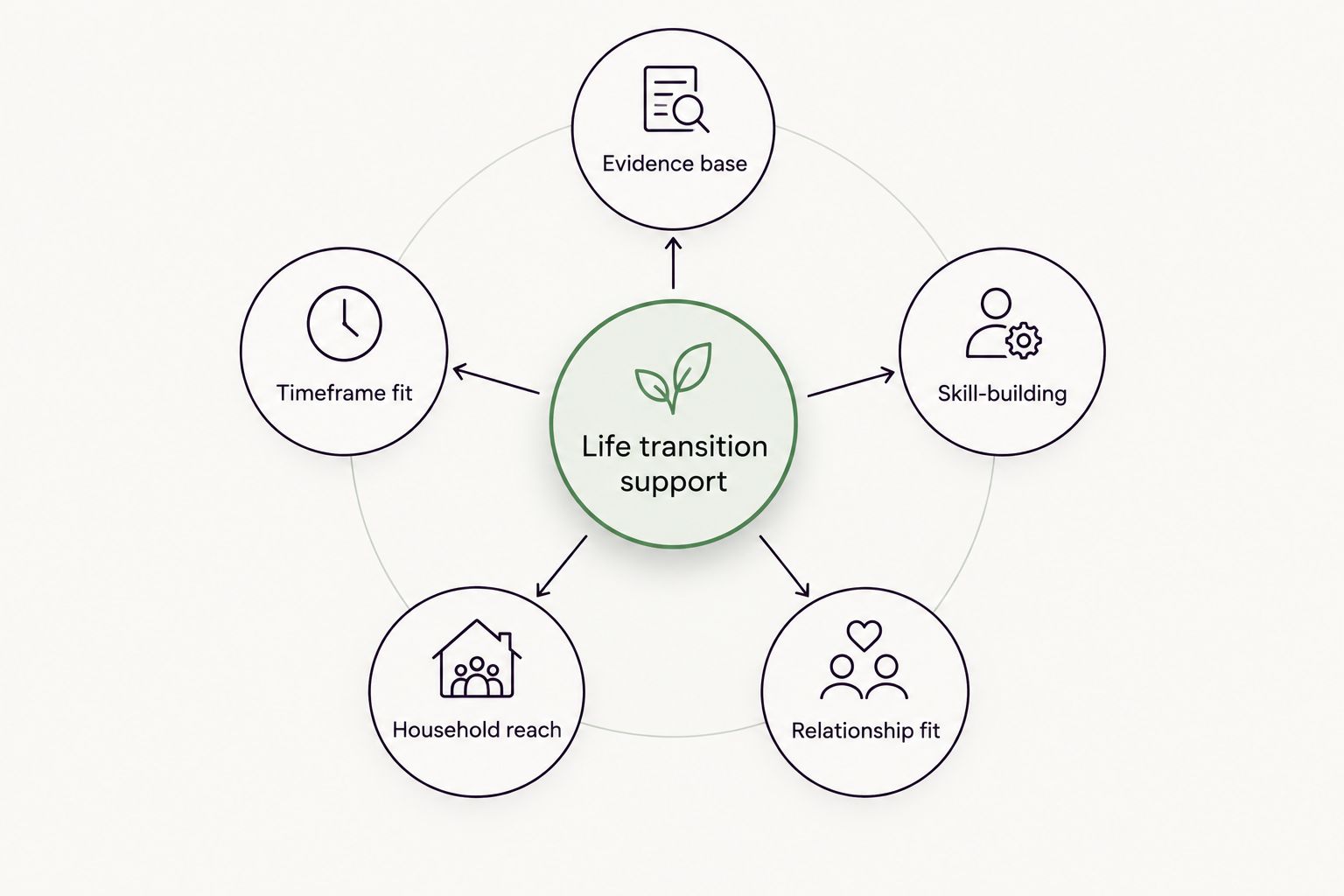
At a glance: therapy approaches for life transitions in 2026
| Approach | Best for | Core focus | Consideration |
|---|---|---|---|
| Cognitive Behavioral Therapy (CBT) | General adjustment stress | Reframing unhelpful thought patterns | Less suited to deep trauma processing alone |
| Family Systems Therapy | Transitions affecting the whole household | Communication and role shifts | Requires willing participation from other family members |
| DBT-informed skills work | High emotional intensity during change | Distress tolerance and emotion regulation | Skills practice takes ongoing repetition outside sessions |
| EMDR-informed / trauma-focused therapy | Transitions that reopen past trauma | Processing distressing memories tied to the change | Not a fast fix; pacing matters |
| Acceptance and Commitment Therapy (ACT) | Values clarification and identity shifts | Aligning choices with personal values | Less structured than CBT for some clients |
| Solution-Focused Brief Therapy (SFBT) | Short, goal-specific support | Concrete next steps in a limited timeframe | Not built for long-standing or complex issues |
1. Cognitive Behavioral Therapy (CBT): best overall for adjustment stress
CBT is a structured, present-focused approach that identifies the thought patterns fueling anxiety or overwhelm during a transition and works to replace them with more workable ones. It's one of the most researched therapy models for adjustment-related distress, which is why it tops this list for 2026.
CBT pros:
- Structured, time-limited, and easy to track progress
- Strong evidence base for anxiety and adjustment difficulties
- Translates well to telehealth sessions
CBT cons:
- Less oriented toward exploring root causes or past trauma
- Requires between-session practice to see full benefit
For readers who want a closer look at specific tools, CBT techniques for managing anxiety covers the methods clinicians draw from most often.
Bottom line: start here if the transition is producing racing thoughts, avoidance, or overwhelm without deeper trauma involved.
2. Family Systems Therapy: best for transitions that reshape a household
Divorce, remarriage, an empty nest, or a new baby change more than one person's routine—they change how a family communicates and who plays what role. Family systems work brings multiple household members into the process to renegotiate those roles directly.
Family Systems Therapy pros:
- Addresses the relationship dynamics a transition disrupts, not just individual stress
- Gives every participant a voice in the adjustment
- Can prevent conflict from calcifying into longer-term estrangement
Family Systems Therapy cons:
- Only works when other family members are willing to attend
- Progress depends on group readiness, not just one person's pace
More detail on this approach is available at family counseling techniques for reconnecting.
Bottom line: best fit when the transition is a shared event, not a solo one.
3. DBT-informed skills work: best for high emotional intensity
Dialectical Behavior Therapy skills—distress tolerance, emotion regulation, interpersonal effectiveness—were originally built for intense emotional swings, and they translate well to transitions that spike anxiety, anger, or grief without warning.
DBT-informed work pros:
- Gives concrete tools for moments of acute distress
- Useful alongside another primary approach, not just standalone
- Skills carry over to future stressors, not just the current transition
DBT-informed work cons:
- Requires consistent practice outside sessions to take hold
- Less focused on exploring why the transition feels destabilizing
Bottom line: add this in when emotional intensity, not just adjustment stress, is the main problem.
4. EMDR-informed and trauma-focused approaches: best when old wounds resurface
Some transitions don't just create new stress—they reopen something older. A divorce can echo childhood abandonment; a job loss can trigger old shame patterns. Trauma-focused approaches process those memories directly rather than only addressing present-day symptoms.
Trauma-focused approaches pros:
- Targets the root memory, not just the current trigger
- Can reduce the intensity of future flare-ups tied to the same theme
- Backed by a strong evidence base for trauma-related distress
Trauma-focused approaches cons:
- Pacing matters; rushing this work can increase distress temporarily
- Not appropriate as a first step without a clinician's assessment
Bottom line: worth exploring with a clinician if the transition feels disproportionately heavy compared to the event itself.
5. Acceptance and Commitment Therapy (ACT): best for values clarification
Some transitions aren't about symptoms at all—they're about identity. Retirement, a career pivot, or becoming a parent can force a values reassessment: who am I now, and what matters? ACT focuses on aligning choices with personal values rather than eliminating discomfort.
ACT pros:
- Well suited to identity and values-based questions
- Doesn't require framing the transition as a problem to fix
- Complements mindfulness-based coping strategies
ACT cons:
- Less structured than CBT, which can feel open-ended for some clients
- Fewer concrete symptom-tracking tools session to session
Bottom line: consider this when the transition raises identity questions more than acute distress.
6. Solution-Focused Brief Therapy (SFBT): best short-term option
SFBT skips lengthy history-taking and focuses on a small number of sessions aimed at a specific, defined goal—useful for a transition with a clear practical edge, like navigating a relocation or a return to work.
SFBT pros:
- Short, goal-specific, and efficient
- Works well for clients who want a defined endpoint
- Keeps sessions focused on forward movement
SFBT cons:
- Not designed for long-standing or layered issues
- May feel too brief for transitions with a trauma component
Bottom line: good fit for a narrow, practical transition with a clear finish line.
How this list was ranked
Each approach was weighed against the six criteria above—evidence base, timeframe fit, skill-building versus insight, household reach, relationship fit, and telehealth flexibility—rather than by popularity. CBT ranks first because it covers the broadest share of general adjustment cases with the strongest published support; the rest of the list fills in the specific situations CBT doesn't cover as well.
Which therapy approach should you choose?
If you're not sure where to start, CBT is the safest default for general life-transition stress in 2026. Move toward Family Systems Therapy if the change involves your household, toward trauma-focused work if the distress feels older than the event itself, and toward SFBT if you want a short, defined course rather than ongoing sessions. None of these decisions need to happen alone—an initial consultation is where a clinician sorts out which lane actually fits.
“The right approach fits the transition, not the diagnosis.”
Talk through your options
A consultation can help match the right approach to your situation.
FAQ
What's the best therapy approach for life transitions in 2026?
Cognitive Behavioral Therapy (CBT) is the best overall approach for general adjustment stress tied to life transitions in 2026. Family Systems Therapy, trauma-focused work, and Solution-Focused Brief Therapy fit more specific situations, like household-wide changes or short, goal-driven support.
Is CBT better than ACT for a career change?
CBT works better when the career change is producing anxiety or overwhelming thoughts, while ACT fits better when the real question is values-based, like whether the new path aligns with who you want to be. Some clients benefit from elements of both.
How long does therapy for a life transition usually take?
Timeframes vary by approach and individual circumstances; Solution-Focused Brief Therapy is designed for a limited number of sessions, while trauma-focused or family work often runs longer. A clinician can outline an expected timeframe after an initial session.
Does family therapy work if only one person wants to attend?
Family Systems Therapy is most effective when the relevant household members participate, since it works on shared communication patterns. Individual therapy remains an option when other family members aren't ready to join.
How much does therapy cost for a life transition in 2026?
Costs vary by provider, session length, and insurance coverage, so exact figures depend on the practice. Verify current rates and any coverage details directly with the provider before starting.
Can telehealth therapy handle life transitions as well as in-person sessions?
CBT, ACT, and DBT-informed skills work generally translate well to telehealth in 2026, since they rely on structured conversation and homework rather than physical presence. Trauma-focused approaches may benefit from an initial in-person assessment depending on the clinician's recommendation.
When should someone start therapy during a life transition, not just after it?
Starting before or during the transition—rather than waiting for a crisis point—often gives more room to build coping skills ahead of the hardest part. There's no required threshold of distress to justify beginning.
What if none of these approaches seem to fit?
Many clinicians blend elements from multiple approaches based on what a client responds to, rather than sticking rigidly to one method. An initial consultation is the place to sort out which combination makes sense.
One last thing
The approach that gets picked first isn't always the one that ends up doing the most work—clinicians frequently start with CBT for structure, then bring in trauma-focused or family work once the initial stress settles enough to see what's underneath it. Treat the first few sessions as diagnostic in the practical sense, not the clinical one: they're there to confirm the method actually fits before committing months to it.