
Six DBT skills stand out for regulating intense emotions in 2026, and they don't work the same way or solve the same problem. Best overall: TIPP for calming a spike fast. Best for daily prevention: PLEASE for lowering your baseline vulnerability to intense emotion. Best for correcting a distorted read on a situation: Check the Facts. The rest of this guide breaks down all six so you can match the skill to the moment instead of guessing.
Dialectical behavior therapy (DBT) was developed by psychologist Marsha Linehan and organized into four skill modules, one of which is Emotion Regulation. The skills below come from that framework and from the Distress Tolerance module, since the two overlap heavily when the goal is managing intense emotion in real time. None of this replaces individualized care — if you're working through a diagnosis or a pattern that isn't shifting on your own, a licensed therapist can help you apply these skills correctly. Havencrest Wellness & Counseling offers DBT-informed counseling across Washington state, in-person and via telehealth.
- TIPP wins for calming an acute emotional spike in minutes; it's the best DBT skill for emotional regulation when the emotion is already at full intensity.
- PLEASE works on the body's baseline vulnerability to strong emotion, not the emotion itself — daily use, not crisis use.
- Check the Facts corrects emotion-driven interpretations before you act on them.
- Opposite Action targets the urge that comes with an emotion, not the emotion itself.
- No DBT skill replaces individualized therapy — these are tools to practice between or alongside sessions.
Why this matters
Most people reach for whatever emotional regulation trick they read online without checking whether it fits the moment. A breathing exercise won't touch a distorted thought, and a cognitive skill won't slow a racing heart fast enough during a genuine spike. The right DBT skill depends on what's actually happening in your body and your thinking at that moment, not on which skill is trending.
DBT skills for emotional regulation in 2026 fall into two rough categories: skills that change your physiology in the moment, and skills that change how you're interpreting or responding to what's happening. Mixing these up is the most common reason people say "DBT doesn't work for me" — they were using a body-based skill for a thinking problem, or vice versa.
What makes an effective DBT skill for emotional regulation
- Evidence behind it — the skill comes from Linehan's published DBT skills training framework, not a wellness trend
- Speed to effect — how fast the skill actually shifts physiology or thought once applied correctly
- Learnability without a therapist present — can it be practiced solo after being taught, or does it need real-time coaching
- Fit across settings — works at home, at work, in public, without special equipment
- Compatibility with other DBT modules — pairs naturally with mindfulness or interpersonal effectiveness skills rather than working against them
- Practicality for daily life in 2026 — realistic to build into an actual week, not just a therapy session
DBT skills for emotional regulation at a glance
| Skill | Best for | Standout feature | Key limitation |
|---|---|---|---|
| TIPP | Calming an acute spike fast | Uses body temperature and breath to shift physiology in minutes | Doesn't address the thought or situation that triggered the spike |
| PLEASE | Daily prevention of emotional vulnerability | Targets sleep, eating, illness, and substance use as root causes | Effects build over days, not minutes |
| Check the Facts | Correcting a distorted read on a situation | Separates the interpretation from the actual evidence | Requires enough calm to think clearly, so it's weaker mid-spike |
| Opposite Action | Emotion doesn't fit the facts or the urge isn't helpful | Directly counters the behavior the emotion is pushing you toward | Can feel counterintuitive and takes practice to trust |
| Wise Mind | Decisions made under emotional pressure | Balances emotional and rational input instead of picking one | Abstract; harder to learn without guided practice |
| Self-Soothe (five senses) | Distress with no clear problem to solve | Simple, low-effort, works almost anywhere | Doesn't build long-term skill on its own |
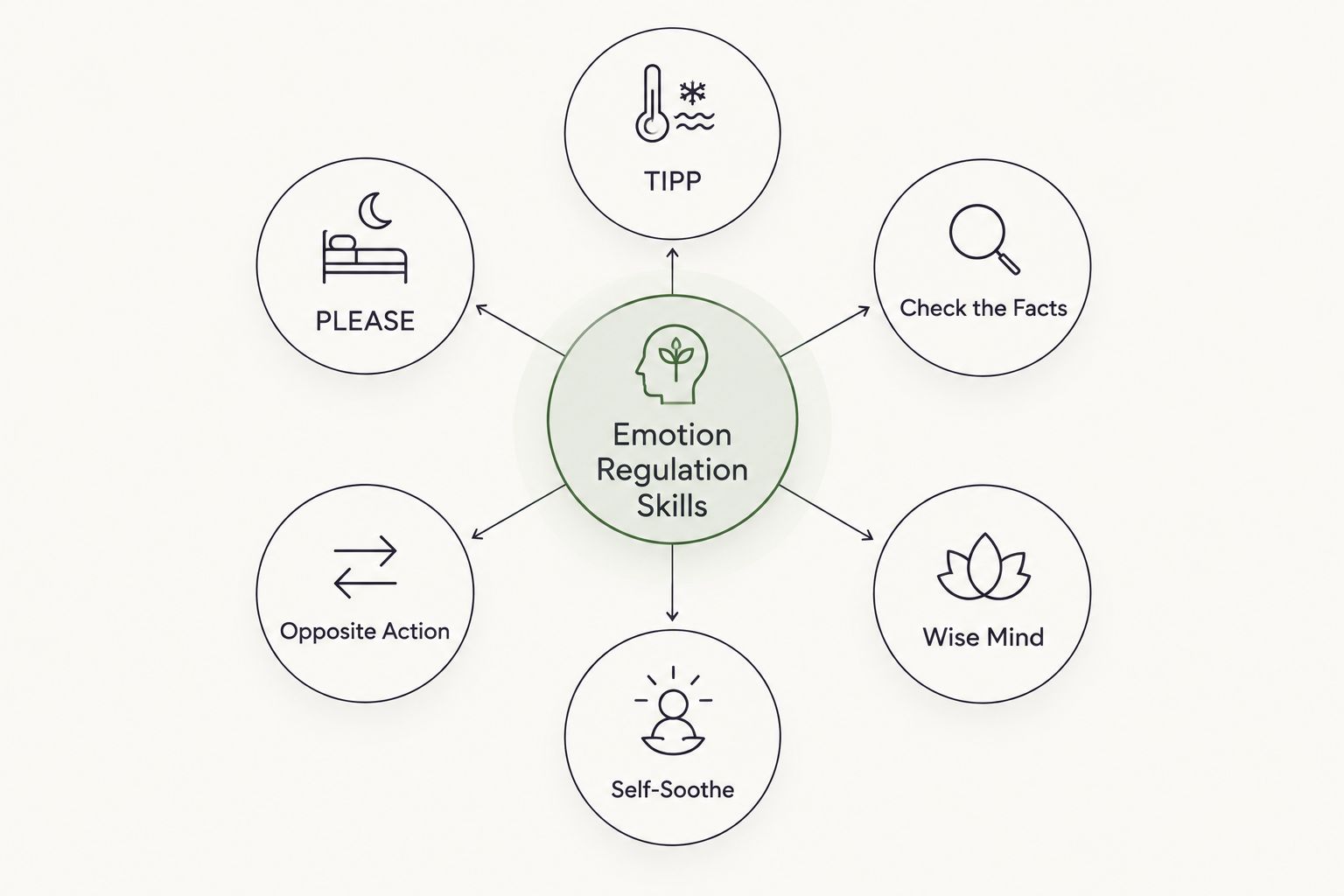
1. TIPP: best DBT skill for calming intense emotional spikes fast
TIPP stands for Temperature, Intense exercise, Paced breathing, and Paired muscle relaxation. It's built for the moment an emotion has already reached a high intensity and you need your body to come down before you can think clearly. Cold water on the face, a short burst of intense movement, or slow paced breathing all work by shifting the body's physiological state directly, rather than trying to reason your way out first.
TIPP pros:
- Works in minutes, not sessions
- No thinking required while the emotion is at its peak
- Portable — cold water, a stairwell, or paced breath are available almost anywhere
TIPP cons:
- Doesn't address what triggered the spike
- Cold water or intense exercise isn't appropriate for everyone with certain heart conditions — check with a physician first
- Effects fade if the underlying situation isn't dealt with afterward
TIPP pricing: No cost to learn or practice; the skill itself requires no materials.
Best for: the first five minutes of an emotional spike, before any other skill can land.
Verdict: Try it first.
2. PLEASE: best DBT skill for daily prevention of emotional vulnerability
PLEASE targets the physical factors that make emotions harder to regulate in the first place: treating PhysicaL illness, balanced Eating, avoiding mood-Altering substances, balanced Sleep, and Exercise. It's not a skill you reach for mid-crisis — it's what lowers how often you hit a crisis at all.
PLEASE pros:
- Addresses root causes rather than symptoms
- Compounds over weeks, reducing emotional intensity across the board
- Overlaps with general health guidance, so it's easy to track
PLEASE cons:
- Slow — results build over days and weeks, not minutes
- Requires consistency, which is hard when you're already emotionally dysregulated
- Easy to neglect because it doesn't feel urgent
PLEASE pricing: No direct cost; may involve existing routines around sleep, food, and movement.
Best for: people whose emotional spikes are frequent and want fewer of them, not just faster recovery from each one.
Verdict: Practice daily.
3. Check the Facts: best DBT skill for correcting a distorted read on a situation
Check the Facts asks you to separate what actually happened from the interpretation your emotion is generating. It's a structured comparison: what are the facts, and does the emotional response fit those facts, or is it responding to an assumption. This is a thinking skill, not a body skill.
Check the Facts pros:
- Directly targets thought distortions instead of just calming the body
- Builds long-term awareness of thinking patterns
- Pairs well with journaling or talking through a situation with a therapist
Check the Facts cons:
- Hard to use mid-spike, when clear thinking is limited
- Requires some self-honesty that can feel uncomfortable
- Not useful when the emotion actually does fit the facts
Check the Facts pricing: No cost; works with a notebook or mental checklist.
Best for: situations where the emotional reaction feels bigger than the actual event warrants.
Verdict: Use situationally.
4. Opposite Action: best DBT skill for when the urge doesn't serve you
Opposite Action works when an emotion is pushing you toward a behavior that won't help — avoiding a hard conversation out of fear, withdrawing out of shame, lashing out in anger. The skill is doing the opposite of what the emotion urges, deliberately and fully, not halfway.
Opposite Action pros:
- Directly interrupts unhelpful behavior patterns
- Effective for emotions like anxiety, shame, and anger specifically
- Builds evidence over time that the emotion doesn't have to control behavior
Opposite Action cons:
- Requires first identifying whether the emotion fits the facts (often paired with Check the Facts)
- Feels unnatural and takes deliberate practice
- Not appropriate when the emotion is actually a reasonable, fact-based response
Opposite Action pricing: No cost; requires willingness more than materials.
Best for: breaking a pattern where the same emotion keeps leading to the same unhelpful behavior.
Verdict: Practice regularly.
5. Wise Mind: best DBT skill for decisions made under emotional pressure
Wise Mind is the DBT concept of the space between purely emotional reactions and purely rational ones — the place where both are considered before acting. It's less a step-by-step technique and more a checkpoint you learn to access before making a decision while emotionally activated.
Wise Mind pros:
- Prevents decisions made entirely from either emotion or logic alone
- Transferable across nearly every DBT skill and life situation
- Becomes faster to access with practice
Wise Mind cons:
- Abstract compared to the other skills on this list
- Harder to learn without a therapist modeling it
- Not a quick fix for an in-the-moment spike
Wise Mind pricing: No cost; typically introduced and practiced in therapy sessions.
Best for: big decisions made while emotions are running high — not small daily irritations.
Verdict: Practice regularly.
6. Self-Soothe with the five senses: best DBT skill for distress with no clear problem to solve
Self-Soothe uses sight, sound, smell, taste, and touch deliberately — a specific scent, warm tea, a soft blanket, calming music — to bring distress down when there's no obvious action to take. It's simple by design.
Self-Soothe pros:
- Low effort and easy to set up in advance
- Works almost anywhere with minimal preparation
- Good entry point for people newer to DBT
Self-Soothe cons:
- Doesn't build long-term skill or address the underlying trigger
- Can become avoidance if used in place of harder skills
- Effects are usually temporary
Self-Soothe pricing: No cost; may involve items already at home.
Best for: distress without a specific problem attached — general overwhelm, a hard day, sensory overload.
Verdict: Use situationally.
How this list was ranked
Each skill was placed against the six criteria above: evidence base, speed to effect, learnability without a therapist present, fit across settings, compatibility with other DBT modules, and practicality for daily life in 2026. TIPP ranks first for speed; PLEASE ranks first for prevention; the rest split by whether the problem is physiological, cognitive, or behavioral.
“The right DBT skill depends on what's happening in your body and your thinking right now, not on which skill is trending.”
Which DBT skill should you use?
If you're in the middle of an intense spike right now, start with TIPP — it's the fastest way to bring your body down before anything else can work. If your emotional spikes are frequent, layer in PLEASE so there's less to regulate in the first place. Once you're calm enough to think, Check the Facts and Opposite Action handle the thought and behavior side. Wise Mind ties it together for bigger decisions, and Self-Soothe fills the gap when there's nothing specific to fix.
These skills work best when practiced with guidance rather than pieced together from articles alone. A therapist trained in DBT can help you identify which module you actually need and correct the parts that are easy to get wrong on your own.
Talk through DBT skills with a therapist
In-person and telehealth counseling across Washington state.
FAQ
What are the best DBT skills for emotional regulation in 2026?
TIPP, PLEASE, Check the Facts, Opposite Action, Wise Mind, and Self-Soothe cover the range from acute spikes to daily prevention. Which one fits depends on whether the problem is physiological, cognitive, or behavioral in the moment.
Is TIPP better than PLEASE for emotional regulation?
They solve different problems, not the same one. TIPP calms an acute spike within minutes; PLEASE lowers how often spikes happen by addressing sleep, eating, and physical health over days and weeks.
Can I learn DBT skills without a therapist?
You can read about DBT skills on your own, but they're typically taught and practiced most effectively with a therapist trained in DBT who can correct misapplication and tailor the skill to your situation.
How long does it take for DBT skills to work?
Body-based skills like TIPP can shift physiology within minutes. Skills like PLEASE and Wise Mind build effectiveness over days to weeks of consistent practice.
What is the difference between distress tolerance and emotion regulation skills in DBT?
Distress tolerance skills, like Self-Soothe and TIPP, help you get through an intense moment without making it worse. Emotion regulation skills, like PLEASE and Check the Facts, work on reducing the frequency and intensity of emotions over time.
Are DBT skills only for people with borderline personality disorder?
DBT was originally developed for borderline personality disorder, but the skills are used broadly in 2026 for anxiety, mood regulation, and general emotional intensity across many types of therapy.
What should I do if a DBT skill doesn't work for me?
Not every skill fits every situation — mismatched skill selection is a common reason a technique feels ineffective. A therapist can help identify whether a different skill, or a modified approach, fits your specific pattern better.
One last thing
The skill people skip most often is PLEASE, because it doesn't feel like "doing DBT" — it feels like basic health advice. But in 2026, most people practicing DBT skills report that spikes get easier to manage once sleep and eating are stable, not because a crisis skill got better. Fix the baseline before judging whether the in-the-moment skills are working.
DBT skills are educational tools, not a substitute for crisis support. If you're in immediate danger or a mental health emergency, contact emergency services or a crisis line right away rather than relying on a self-regulation skill alone.