
Best overall EMDR alternative for trauma in 2026: Cognitive Processing Therapy (CPT). Best for avoidance-driven symptoms: Prolonged Exposure (PE). Best low-burden option: Written Exposure Therapy (WET). Best for high physiological arousal or body-held tension: Somatic Experiencing.
- Cognitive Processing Therapy is the best overall EMDR alternative for trauma, backed by the strongest trial evidence.
- Prolonged Exposure suits clients whose PTSD symptoms center on avoiding trauma reminders and memories.
- Written Exposure Therapy needs only five sessions, the lowest time commitment among evidence-based trauma treatments.
- Somatic Experiencing and Brainspotting fit clients who find direct talk-based trauma processing overwhelming.
- A licensed clinician, not a self-assessment, should match your symptoms to the right trauma treatment approach.
Why this matters
EMDR gets most of the attention in trauma treatment conversations, but it is not the only evidence-based option, and it is not the right fit for everyone. Some clients find bilateral stimulation distracting or uncomfortable. Others live in areas where EMDR-trained clinicians are scarce, or their symptoms respond better to a structured, talk-based protocol than to a memory-reprocessing technique.
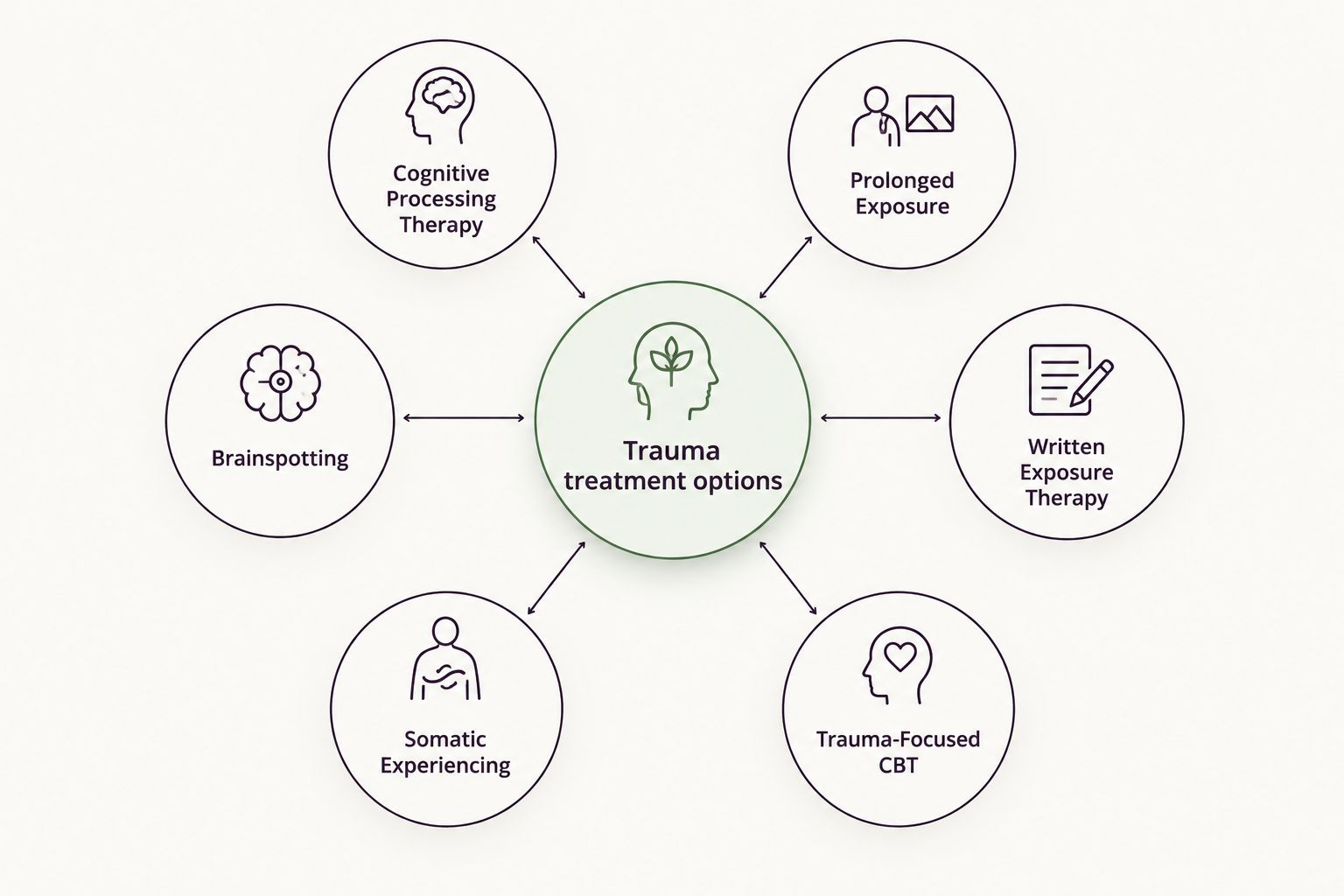
The clinicians at Havencrest Wellness & Counseling work with clients throughout Washington state, in person and via telehealth, to match trauma symptoms to an approach with real research behind it — not whichever modality happens to be trending. This guide breaks down the six most established EMDR alternatives for trauma treatment heading into 2026, what each one asks of a client, and who tends to do best with it.
What makes the best EMDR alternative for trauma
Not every trauma-focused therapy is built the same way. Before comparing approaches, weigh them against these criteria:
- Evidence strength — how many randomized controlled trials and how consistently the approach outperforms wait-list or supportive-therapy controls
- Session structure — a fixed, time-limited protocol versus an open-ended course
- Mechanism — cognitive restructuring, gradual exposure, or body-based nervous system regulation
- Symptom fit — whether the approach targets avoidance, hyperarousal, intrusive memories, or dissociation most directly
- Clinician availability — how widely trained licensed therapists are in the model
- Client tolerance — how directly the method asks someone to revisit or narrate the traumatic memory
EMDR alternatives at a glance
| Approach | Best for | Mechanism | Typical course length | Key limitation |
|---|---|---|---|---|
| Cognitive Processing Therapy (CPT) | Avoidance and stuck negative beliefs | Structured cognitive restructuring | 12 sessions | Requires written trauma accounts |
| Prolonged Exposure (PE) | Avoidance tied to specific memories or situations | Gradual imaginal and in-vivo exposure | 8-15 sessions | Symptoms can intensify early in treatment |
| Written Exposure Therapy (WET) | Clients wanting the shortest course | Brief structured written exposure | 5 sessions | Less studied for complex or relational trauma |
| Trauma-Focused CBT (TF-CBT) | Children and adolescents | Trauma narrative work plus caregiver sessions | 8-25 sessions | Needs caregiver participation |
| Somatic Experiencing | High physiological arousal or body-held tension | Nervous system regulation with minimal verbal recounting | Open-ended, varies by client | Fewer large randomized trials than CPT or PE |
| Brainspotting | Clients who found EMDR too intense | Sustained eye position paired with body awareness | Open-ended | Limited large-scale trial evidence |
1. Cognitive Processing Therapy: best overall EMDR alternative for trauma
CPT is a structured, 12-session protocol that helps clients identify and challenge the beliefs trauma left behind — thoughts about safety, trust, or self-blame that keep symptoms active. It is one of the most-studied trauma treatments available, with decades of randomized trial data behind it.
CPT pros:
- Fixed 12-session length makes the time commitment predictable
- Strong trial evidence across combat, sexual assault, and civilian trauma populations
- Widely taught, so trained clinicians are easier to find than for newer somatic models
CPT cons:
- Requires writing a detailed trauma account, which some clients find difficult early on
- Less body-focused, so clients whose symptoms are mostly physical may want a complementary approach
Best for: clients who want a structured, time-limited course with the deepest evidence base. Verdict: strong first choice to raise with a licensed clinician.
2. Prolonged Exposure: best for avoidance-driven trauma symptoms
PE targets the avoidance loop directly — the places, people, or memories a client has been sidestepping since the trauma. Treatment moves gradually through imaginal recounting of the memory and real-world exposure to avoided situations, typically over 8 to 15 sessions.
Prolonged Exposure pros:
- Directly reduces avoidance behaviors that maintain PTSD symptoms over time
- Flexible session count lets the pace match the client's tolerance
- Extensive research support, including in veteran and first-responder populations
Prolonged Exposure cons:
- Symptoms sometimes spike in the first few sessions before improving
- Not ideal for clients in active crisis or with unstable housing or safety concerns
Best for: clients whose PTSD looks like avoidance — skipped appointments, avoided neighborhoods, refused conversations. Verdict: worth discussing when avoidance is the dominant symptom.
3. Written Exposure Therapy: best low-burden EMDR alternative
WET was designed to deliver exposure-based benefits in far fewer sessions. Clients write about the traumatic event for a set period during each of five sessions, with brief clinician check-ins before and after.
Written Exposure Therapy pros:
- Only five sessions, the shortest course among evidence-based trauma treatments
- Minimal between-session homework compared to CPT or PE
- Lower dropout rates in published trials, likely tied to the shorter time commitment
Written Exposure Therapy cons:
- Newer than CPT and PE, so the evidence base, while solid, is smaller
- Less tested for clients with multiple or ongoing traumatic experiences
Best for: clients who want meaningful symptom reduction without a months-long commitment. Verdict: a reasonable option to ask about when time is the limiting factor.
4. Trauma-Focused CBT: best for children and adolescents
TF-CBT combines trauma narrative work with caregiver involvement, built specifically for younger clients. Sessions run 8 to 25 depending on the child's needs, alternating between the child and joint caregiver sessions.
TF-CBT pros:
- Built and validated specifically for children and teens, not adapted from adult protocols
- Involves caregivers directly, which supports what happens outside session
- One of the most researched trauma treatments for youth
TF-CBT cons:
- Requires a willing, available caregiver, which is not always possible
- Longer course than WET or CPT in more complex cases
Best for: families seeking trauma treatment for a child or adolescent. Verdict: the default starting point for younger clients.
5. Somatic Experiencing: best for body-held trauma symptoms
Somatic Experiencing works with physical sensation rather than a detailed verbal account of the event. Sessions focus on noticing and releasing the nervous system activation trauma leaves behind, at a pace the client's body can tolerate.
Somatic Experiencing pros:
- Does not require recounting the traumatic event in detail
- Often a good fit for clients who feel overwhelmed by talk-heavy approaches
- Addresses physical symptoms — tension, numbness, chronic activation — that cognitive approaches can miss
Somatic Experiencing cons:
- Fewer large randomized controlled trials compared to CPT or PE
- Open-ended course length makes the time commitment harder to predict
Best for: clients whose trauma shows up mostly in the body — chronic tension, dissociation, or a nervous system that will not settle. Verdict: consider alongside a cognitive approach, not always instead of one.
6. Brainspotting: best for clients who found EMDR overstimulating
Brainspotting shares some theoretical roots with EMDR — it uses a fixed eye position paired with body awareness instead of bilateral eye movements. Clients who found EMDR's back-and-forth stimulation uncomfortable sometimes tolerate this better.
Brainspotting pros:
- Similar underlying mechanism to EMDR without the eye-movement component
- Sessions are typically less structured, which some clients prefer
- Growing use among trauma-focused clinicians
Brainspotting cons:
- Limited large-scale trial evidence compared to CPT, PE, or TF-CBT
- Fewer clinicians trained in the model than in longer-established approaches
Best for: clients who tried EMDR and found the stimulation itself the problem, not the memory work. Verdict: a reasonable next step after an EMDR trial that didn't fit.
How we ranked these EMDR alternatives
CPT and PE rank highest because trial evidence and clinician availability are strongest for both. WET ranks next for its low time burden despite a smaller research base. TF-CBT is ranked by population fit rather than general superiority — it is the strongest option specifically for children and teens. Somatic Experiencing and Brainspotting rank lower only because their trial evidence is thinner, not because they lack clinical value for the right client.
Which EMDR alternative should you choose?
If you want the most-studied option with a fixed timeline, start the conversation with Cognitive Processing Therapy. If avoidance is your main symptom, Prolonged Exposure targets that pattern directly. If time is the barrier, Written Exposure Therapy delivers a full course in five sessions. If your trauma shows up as tension or dissociation rather than avoidance, Somatic Experiencing or Brainspotting may fit better than a purely cognitive approach.
None of this replaces an actual clinical assessment. A licensed therapist can weigh your symptom pattern, history, and preferences in a way a list like this cannot.
Talk through your options
Discuss trauma treatment options with a licensed clinician, in person or by telehealth.
FAQ
What's the best EMDR alternative for trauma?
Cognitive Processing Therapy has the strongest and most consistent trial evidence among EMDR alternatives as of 2026. The right choice still depends on your specific symptoms and a clinician's assessment.
Is CPT as effective as EMDR?
Research generally shows CPT and EMDR produce comparable symptom reduction for PTSD. The 2017 American Psychological Association guideline gave CPT a stronger recommendation than EMDR based on trial quality at the time.
How long does trauma therapy take without EMDR?
It depends on the approach: Written Exposure Therapy runs 5 sessions, CPT runs about 12, and Prolonged Exposure typically runs 8 to 15. Somatic approaches like Somatic Experiencing are often open-ended.
Can I combine EMDR with other trauma therapies?
Some clinicians integrate approaches, such as pairing somatic work with cognitive processing, but this should be planned with a licensed therapist rather than self-directed.
Is Brainspotting evidence-based?
Brainspotting has growing clinical use and some supporting studies, but its research base is smaller than CPT, PE, or TF-CBT as of 2026.
Does Somatic Experiencing require talking about the trauma in detail?
No. Somatic Experiencing focuses on physical sensation and nervous system regulation rather than a detailed verbal account of the traumatic event.
What's the best trauma treatment for children?
Trauma-Focused CBT is the most researched trauma treatment built specifically for children and adolescents, and it involves caregivers directly in the process.
Does insurance cover EMDR alternatives like CPT or PE?
Coverage varies by plan and provider. Check directly with your insurance carrier and the clinic you're considering before starting treatment.
One last thing
The American Psychological Association's 2017 clinical practice guideline for PTSD in adults gave CPT, Prolonged Exposure, and trauma-focused CBT a "strong" recommendation — but EMDR only received a "conditional" one, largely because fewer high-quality trials existed for it at the time. That gap has narrowed since, but it is a useful reminder heading into 2026: EMDR's popularity does not automatically mean it outranks every alternative on the evidence. The clinicians at Havencrest Wellness & Counseling weigh that research directly with each client rather than defaulting to whichever therapy is best known.