
Family counseling isn't one method — it's a set of distinct clinical approaches, and each one is built for a different kind of family struggle. Best overall: Structural Family Therapy, for reorganizing roles and boundaries. Best for rebuilding trust after conflict: Emotionally Focused Family Therapy. Best for multigenerational patterns: Bowenian Family Systems Therapy. Six of the best family counseling techniques used in 2026 are ranked below by the specific situation each one fits.
- Structural Family Therapy ranks best overall for families reorganizing roles after a major change like divorce or a new baby.
- Emotionally Focused Family Therapy (EFFT) is the strongest pick for repairing trust after conflict or betrayal.
- Bowenian Family Systems Therapy fits families untangling repeating patterns across generations.
- Solution-Focused Brief Therapy suits families that want short-term, goal-specific work over open-ended exploration.
- Multisystemic Therapy is built for teens whose behavior involves school, peers, or the legal system.
Why this matters
Most families searching for counseling don't know that "family therapy" isn't a single technique — it's an umbrella covering several distinct clinical models, each with its own research base and its own idea of what's actually broken. Picking the wrong one wastes months.
A family dealing with a teenager's school refusal needs a different approach than a family working through a parent's remarriage or a long-running conflict between adult siblings. Havencrest Wellness & Counseling offers family counseling in Washington state, in person and via telehealth, and clinicians there typically draw on more than one of these models depending on what a family brings into the room.
This ranking exists so you can walk into a consultation already knowing what to ask for, instead of hoping the first session sorts it out.
What makes the best family counseling techniques
Each technique below was ranked against the same six criteria:
- Evidence base — peer-reviewed research support behind the model, not just clinical tradition
- Fit for the presenting concern — communication breakdown, trauma, grief, or behavioral issues
- Developmental appropriateness — whether the model works for young children, teens, or adult family members
- Typical structure — how sessions are organized and how long treatment usually runs
- Primary target — whether the technique focuses on behavior, emotion, or family structure
- Clinician availability — how commonly trained therapists practice the model in 2026
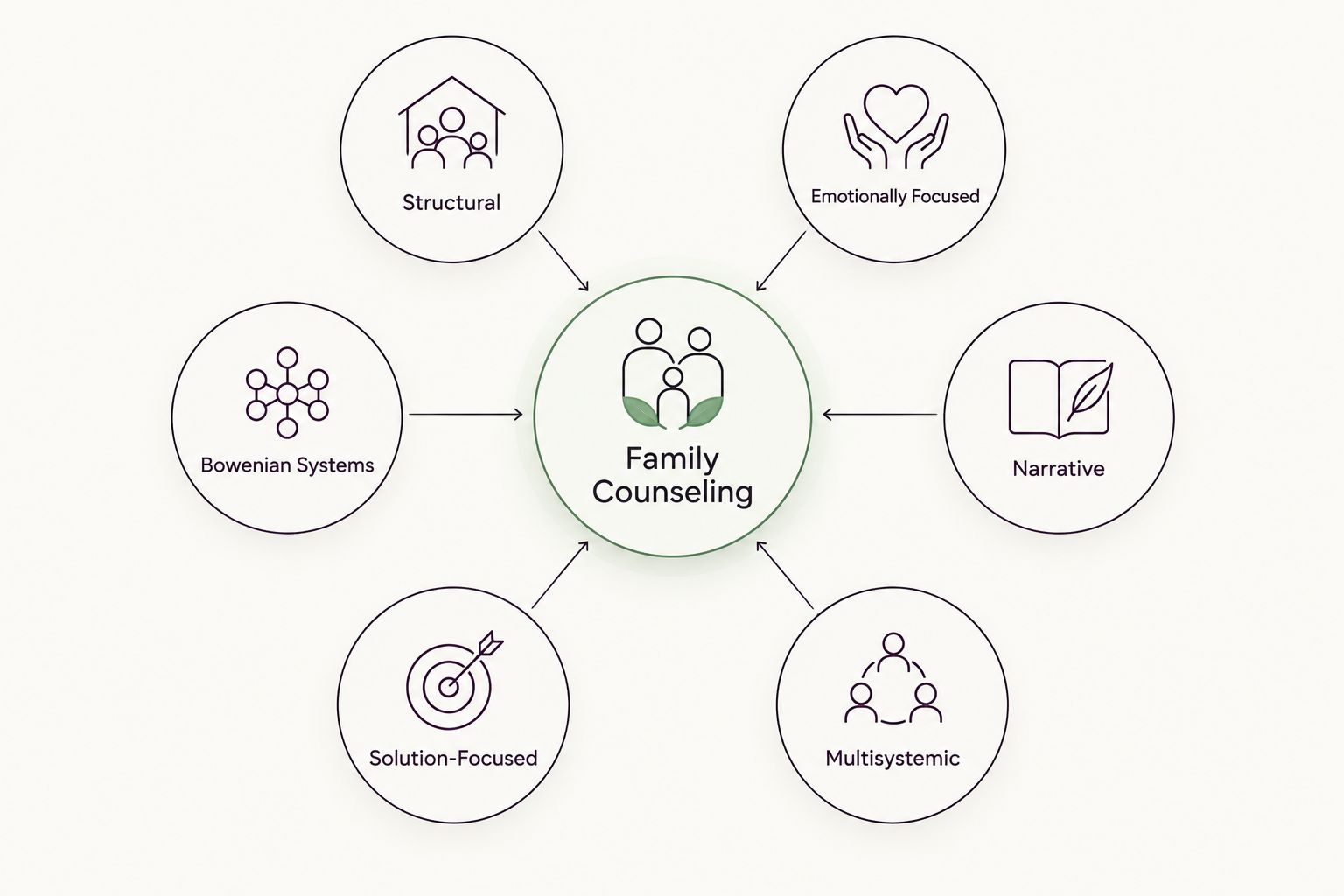
Family counseling techniques at a glance
| Technique | Best for | Standout feature | Key limitation |
|---|---|---|---|
| Structural Family Therapy | Reorganizing roles and boundaries | Maps the family's power structure in real time | Less suited to processing a single traumatic event |
| Emotionally Focused Family Therapy | Rebuilding trust after conflict | Targets the emotional bond directly, not just behavior | Requires willingness from all members to be vulnerable |
| Bowenian Family Systems Therapy | Multigenerational patterns | Traces conflict back across generations, not just the present crisis | Slower to produce visible change |
| Narrative Therapy | Separating identity from the problem | Reframes "the problem" as external to any one person | Less structured for families wanting concrete steps |
| Solution-Focused Brief Therapy | Short-term, goal-specific work | Built for a defined number of sessions with a clear target | Not designed for deep-rooted or long-standing conflict |
| Multisystemic Therapy | Teens involved with school or legal systems | Coordinates with schools, courts, and community supports | Intensive; not typical for general communication issues |
1. Structural Family Therapy: best family counseling technique for reorganizing roles
Structural Family Therapy looks at how a family is organized — who holds authority, where the boundaries sit between parents and children, and where those boundaries have blurred or hardened. A therapist working this model often makes the family's structure visible in session, then works with them to adjust it.
It tends to be the first approach clinicians reach for after a divorce, remarriage, or any shift that scrambles who's responsible for what inside a household.
Structural Family Therapy pros:
- Produces visible, practical changes to daily roles fairly quickly
- Works well with children present in session
- Strong evidence base, particularly for families with young children
Structural Family Therapy cons:
- Focuses more on structure than on underlying emotional wounds
- Less effective as a standalone approach after a specific trauma
Best for: families reorganizing after a major life change. Verdict: strong fit.
2. Emotionally Focused Family Therapy: best for rebuilding trust after conflict
Emotionally Focused Family Therapy (EFFT) treats the emotional bond between family members as the thing to repair, not just the arguments on the surface. Sessions work through the fear, hurt, or shame sitting underneath repeated conflict.
It's frequently used after a betrayal, a parenting rupture, or a long stretch of guarded, defensive communication.
Emotionally Focused Family Therapy pros:
- Addresses the emotional root of conflict, not only the behavior
- Strong research support, originally developed from attachment theory
- Effective for repairing specific ruptures, like a breach of trust
Emotionally Focused Family Therapy cons:
- Asks family members to be emotionally vulnerable, which some resist
- Slower going if one member refuses to engage
Best for: families rebuilding trust after a specific rupture. Verdict: strong fit.
3. Bowenian Family Systems Therapy: best for multigenerational patterns
Bowenian therapy looks past the current crisis to the patterns repeating across generations — the same conflict style, the same distancing, the same triangulation showing up in a grandparent, a parent, and now a child. The therapist often maps a genogram to trace it.
This technique fits families who notice, often on their own, that "we keep doing what my parents did."
Bowenian Family Systems Therapy pros:
- Explains why a pattern feels inherited rather than invented
- Reduces blame by locating the pattern in the system, not one person
- Suited to long-term work on deep-seated dynamics
Bowenian Family Systems Therapy cons:
- Change tends to be gradual, not immediate
- Requires reflection some family members aren't ready for early on
Best for: families untangling patterns that span generations. Verdict: worth exploring.
4. Narrative Therapy: best for separating identity from the problem
Narrative Therapy works by externalizing the problem — treating "the anger" or "the anxiety" as something the family faces together, rather than something one member simply is. This shifts a family away from blame and toward a shared story they can rewrite.
It's a strong fit when shame or labeling has taken over the family's language about one member.
Narrative Therapy pros:
- Reduces blame and shame directed at one family member
- Gives families new, less loaded language to describe their struggle
- Works well alongside other techniques, not only alone
Narrative Therapy cons:
- Less structured than approaches built around concrete steps
- Progress can be harder to measure session to session
Best for: families where blame or shame has become the main story. Verdict: situational fit.
5. Solution-Focused Brief Therapy: best for short-term, goal-focused work
Solution-Focused Brief Therapy (SFBT) skips deep exploration of the past in favor of identifying a concrete goal and building toward it across a defined number of sessions. Questions center on what's already working, however small, and how to do more of it.
Families with a specific, nameable goal — better communication before a wedding, fewer arguments over screen time — tend to move fastest here.
Solution-Focused Brief Therapy pros:
- Efficient, with a clear endpoint families can plan around
- Builds on existing family strengths rather than deficits
- Practical for families new to counseling and unsure what to expect
Solution-Focused Brief Therapy cons:
- Not designed for long-standing or deeply rooted conflict
- Can feel too surface-level for families wanting deeper processing
Best for: families with a specific, time-bound goal. Verdict: worth exploring.
6. Multisystemic Therapy: best for teens involved with school or legal systems
Multisystemic Therapy (MST) was built for teens whose behavior spills beyond the household — truancy, conflict with police, or serious conduct issues at school. The therapist works with the family and coordinates directly with schools, courts, or other community systems involved.
It's intensive by design and typically reserved for situations where a teen's behavior has already drawn in outside institutions.
Multisystemic Therapy pros:
- Strong research base specifically for at-risk adolescent behavior
- Coordinates across school, family, and legal systems instead of working in isolation
- Addresses root causes rather than only the immediate incident
Multisystemic Therapy cons:
- More intensive and time-consuming than general family counseling
- Not designed for families without significant external system involvement
Best for: families whose teen's behavior involves school or legal systems. Verdict: situational fit.
How this ranking was built
Each technique was scored against the same six criteria — evidence base, fit for the presenting concern, developmental appropriateness, session structure, primary target, and clinician availability in 2026. Structural Family Therapy and Emotionally Focused Family Therapy rank highest because they cover the two most common reasons families seek counseling: reorganizing after change, and repairing trust after conflict. The others rank lower only because they solve narrower problems, not because they're weaker clinically.
Talk through your family's situation
A consultation can help match your family to the right approach.
Which family counseling technique should you choose?
If you're not sure where your family fits, start with the presenting concern rather than the technique name. Structural Family Therapy is the default choice for families reorganizing after a life change, because it produces visible shifts in roles fastest. If the core issue is a breach of trust, Emotionally Focused Family Therapy is the better starting point. If a teenager's behavior has already reached school or legal systems, Multisystemic Therapy fits the situation more precisely than general counseling.
Many clinicians in 2026 blend these approaches rather than practicing one in isolation, and a good first consultation will name which elements apply to your family before treatment starts.
FAQ
What is the most effective family counseling technique?
There's no single most effective technique — Structural Family Therapy and Emotionally Focused Family Therapy have the strongest overall research support, but the right fit depends on whether the family is reorganizing roles or repairing trust.
Is Structural Family Therapy or Emotionally Focused Family Therapy better for repairing trust?
Emotionally Focused Family Therapy is built specifically to repair the emotional bond after a rupture, while Structural Family Therapy focuses more on roles and boundaries than on the emotional wound itself.
How long does family counseling usually take to show progress?
This varies by family and by technique — Solution-Focused Brief Therapy is designed around a short, defined number of sessions, while Bowenian Family Systems Therapy typically works over a longer period since it addresses multigenerational patterns.
Can family counseling work if only some members attend session?
Many techniques, including Structural and Bowenian approaches, can still make progress with partial attendance, though outcomes generally improve when the key people involved in the conflict are present.
Is family counseling covered by insurance in 2026?
Coverage depends entirely on the specific plan, so check directly with your insurance provider before scheduling; a clinic can typically help you verify benefits ahead of your first session.
What's the difference between family counseling and individual therapy?
Individual therapy focuses on one person's experience, while family counseling treats the family unit itself as the client, looking at patterns of communication and relationship between members.
How do I choose the right family counseling approach for my situation?
Start with the presenting concern rather than the technique name — reorganizing roles, rebuilding trust, or addressing a teen's behavior each point toward a different approach, and a consultation can help narrow it down.
Does telehealth family counseling work as well as in-person sessions?
Telehealth family counseling can support most of these techniques, including Structural and Solution-Focused approaches, though families should discuss with a clinician whether their specific situation is better suited to in-person sessions.
One last thing
Few family therapists practice a single technique in its pure textbook form by 2026 — most integrate two or three depending on what a family brings to the first session. If a clinician can't explain which approach they're drawing from and why, that's a fair question to ask before committing to a full course of sessions.