
Calling your insurance company to ask about mental health coverage usually means fifteen minutes on hold followed by acronyms nobody explained to you. Verify your benefits once, before your first appointment, and you walk into therapy knowing what a session actually costs and what your plan covers.
- Verify outpatient mental health benefits before booking to avoid billing surprises in 2026.
- Ask your insurer about copay, deductible status, and telehealth parity in one call.
- Out-of-network plans usually require a superbill for reimbursement, not a phone call.
- Federal parity law requires mental health coverage comparable to medical coverage on most plans.
Why this matters
Most people don't find out their plan's mental health terms until a bill shows up weeks after a session. That's backwards. The Mental Health Parity and Addiction Equity Act requires most group health plans to cover mental health and substance use treatment at parity with medical and surgical benefits — meaning your insurer generally can't impose stricter visit limits or higher cost-sharing on therapy than it does on a doctor's visit for a broken wrist.
Knowing that gives you leverage on the phone. If a representative tells you therapy isn't covered or is capped at a handful of visits per year, that's worth a follow-up question, not a shrug. Checking how much therapy costs in Washington in 2026 before you call also gives you a baseline to compare against whatever your insurer quotes.
Before you start
- Your insurance card (front and back) — the member services number and group ID live on the back, not the front.
- A notepad or notes app open during the call — representatives give verbal quotes that aren't binding unless you write down the date, time, and rep's name.
- The gotcha: telehealth mental health benefits sometimes carry different cost-sharing than in-person visits under the exact same plan. Ask about both separately — don't assume they match.
Locate your mental health benefits
- Log into your insurer's member portal and search for "behavioral health" or "mental health" in the benefits summary — insurers rarely use the word "therapy" in their own documents.
- Note your deductible (how much you pay before insurance starts covering visits) and how much of it you've met this year.
- Note your copay or coinsurance for an in-network outpatient visit.
Expected result: you have a dollar figure or percentage for what an in-network session costs you, plus a deductible balance.
Call your insurer's member services line
- Dial the number on the back of your card and ask specifically for outpatient mental health benefits — general customer service reps sometimes route mental health questions to a separate behavioral health line.
- Ask whether your plan requires a referral or prior authorization before your first session.
- Confirm whether telehealth sessions are billed the same as in-person visits under your plan.
- Request the call reference number before you hang up.
Expected result: you have a documented answer for coverage, cost-sharing, and any authorization steps, tied to a reference number you can cite later if a claim gets processed differently than described.
Ask the right questions
Use this exact phrasing — insurance reps respond faster to specific benefit-category language than to general questions:
- "Is outpatient mental health counseling covered under my plan?"
- "What is my copay or coinsurance for an in-network outpatient visit?"
- "How much of my deductible have I met this year?"
- "Does my plan require a referral or prior authorization for therapy?"
- "Are telehealth sessions covered the same as in-person sessions?"
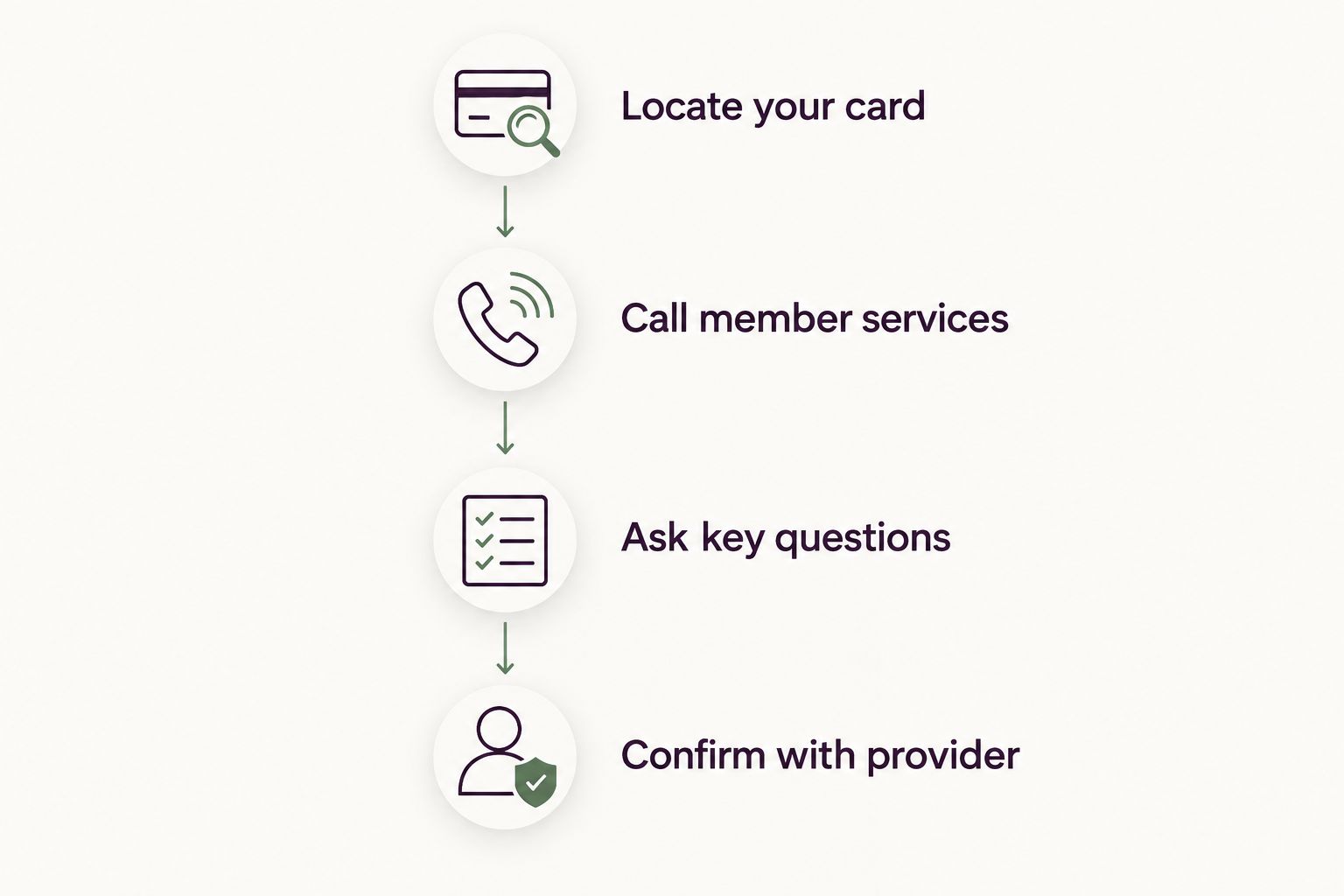
Confirm coverage with your provider before session one
Once you have the insurer's answers, confirm them against what the practice tells you. A front desk or intake coordinator at Havencrest Wellness & Counseling can verify which plans the practice is in-network with and give you a session cost estimate based on the benefits you've already gathered.
- Share your insurer's quoted copay and deductible status with the practice.
- Ask the practice to confirm your specific plan is in-network before your first session — network status can vary by plan even within the same insurance company.
- Get the estimated per-session cost in writing or email before you book.
Expected result: no gap between what your insurer told you and what you're billed.
Using out-of-network benefits instead
If your chosen provider isn't in-network with your plan, you may still have out-of-network benefits worth using.
- Ask your insurer during the same call: "What is my out-of-network reimbursement rate for outpatient mental health visits?"
- Ask the provider for a superbill — an itemized receipt with diagnosis and procedure codes — after each paid session.
- Submit the superbill through your insurer's claims portal or by mail, following their out-of-network claim process.
Expected result: partial reimbursement arrives on your insurer's normal claims timeline, separate from what you paid the provider directly.
Troubleshooting
- The rep says mental health isn't covered at all. Ask them to check again under "behavioral health" specifically — this is rarely accurate for plans regulated by parity law, and it's worth a second look or a supervisor request.
- A claim gets denied after a session you confirmed was covered. File an appeal citing your call reference number and the date you verified benefits.
- You're told prior authorization is required but weren't told before booking. Ask your provider's office to submit the authorization request — most practices handle this routinely and it doesn't require you to restart the process.
- Telehealth is quoted at a different rate than in-person. Ask directly whether that's a parity violation for your plan type — self-funded employer plans sometimes fall outside state telehealth parity rules, while fully insured Washington plans generally don't.
- Your deductible resets mid-treatment. This typically happens at the start of a new plan year — confirm your renewal date before assuming your cost-sharing will stay the same.
Ready to check your coverage?
Talk through your benefits and next steps at your own pace.
Customize your workflow
Once your benefits are verified, the next decision is which type of therapy fits what you're working through. If anxiety is the primary concern, reviewing evidence-based approaches for anxiety alongside your coverage details helps you match a treatment style to a cost you've already confirmed. If depression is the focus, the same logic applies before you commit to a specific modality.
FAQ
How do I find out if my insurance covers therapy in Washington?
Call the member services number on your insurance card and ask specifically about outpatient mental health benefits. Confirm your copay, deductible status, and whether telehealth is covered at the same rate as in-person visits.
What questions should I ask my insurance company about therapy coverage?
Ask about copay or coinsurance for outpatient visits, your remaining deductible, whether prior authorization is required, and whether telehealth sessions are billed the same as in-person sessions. Write down the rep's name and a call reference number.
Does insurance cover telehealth therapy the same as in-person sessions?
Often yes, but not always — this depends on your specific plan, and self-funded employer plans can differ from fully insured Washington plans. Confirm this separately from your in-person benefit during the same call.
What is a superbill and when do I need one?
A superbill is an itemized receipt with diagnosis and procedure codes that you submit to your insurer for reimbursement when using out-of-network benefits. You typically request one from the provider after each paid session.
Do I need a referral to start therapy in Washington?
Some plans require a referral or prior authorization before covering outpatient mental health visits, while others don't. Ask your insurer directly during your benefits verification call, since this varies by plan.
What happens if my deductible resets during treatment?
Your cost-sharing usually increases back to the pre-deductible rate until you meet the new deductible, typically at the start of a new plan year. Confirm your renewal date so you can plan around the cost change.
Can I appeal a denied therapy insurance claim?
Yes — most insurers have a formal appeal process, and citing the date and reference number from your original benefits verification call strengthens the appeal. Ask your provider's billing staff if they can assist with documentation.
Is mental health therapy required to be covered the same as medical care?
Under the Mental Health Parity and Addiction Equity Act, most group health plans must cover mental health treatment at parity with medical and surgical benefits. This generally means comparable visit limits and cost-sharing, though exceptions exist for certain plan types.
One last thing
Federal parity law means your insurer generally can't cap therapy visits more tightly than it caps physical therapy or specialist visits — most people never ask about this, and most reps won't volunteer it. If a call center representative quotes you a visit limit that sounds arbitrary, ask them to confirm it in writing; that single follow-up question resolves more coverage disputes in 2026 than any appeal filed after the fact.