
Bouncing between a therapist's office and a prescriber's exam room with no communication between the two wastes appointment time and can quietly work against your treatment plan. Instead of hoping your psychiatrist and your therapist compare notes on their own, set up a formal coordination workflow through Havencrest Wellness & Counseling so both providers see the same treatment goals and medication changes get discussed where you actually talk about them.
- A signed release of information is the one requirement that makes therapy and medication management coordination possible in 2026.
- Verbal consent isn't enough — HIPAA requires written authorization before any two providers can share your records.
- Psychiatrist-led and primary care-led medication management follow different visit rhythms, so match your update schedule to whichever one you use.
- Flag medication changes to your therapist the same session you learn about them, not the next one.
Why this matters
Therapy and medication work through different mechanisms, and when the two providers running them don't talk, gaps show up as symptoms instead of paperwork problems. A prescriber who doesn't know you've started EMDR for trauma might read new sleep disruption as a medication side effect instead of processing work. A therapist who doesn't know your dose just increased might mistake a flat affect for disengagement in session.
Coordinated care closes that gap — it doesn't require either provider to change how they practice, just to see the same picture. This matters more in 2026 than it did a few years ago, since more people split care between telehealth therapists and in-person prescribers who never cross paths otherwise.
Before you start
- A signed release of information (ROI) naming both your therapist and your prescriber by name and practice — verbal permission at an appointment does not satisfy HIPAA.
- Current contact details for both offices: fax number, secure clinical email, or the portal each practice uses for records requests.
- The gotcha that trips people up: many prescriber offices only process coordination requests during specific administrative windows each week, so a release submitted the same week as your appointment often arrives too late to be reviewed before you're seen. Send it at least two weeks ahead.
Set up the release of information
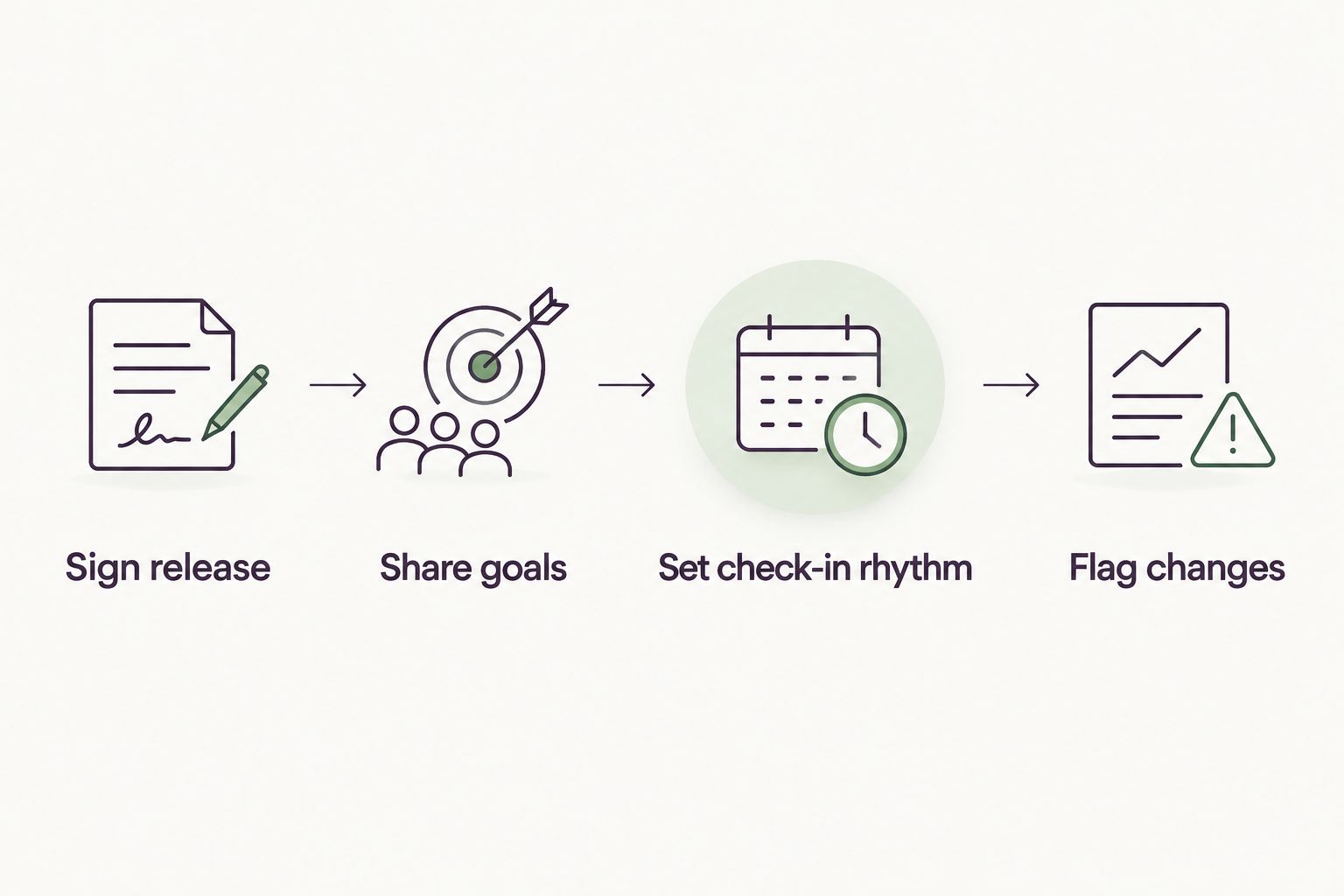
- Ask your Havencrest therapist for the practice's Release of Information form during your next session, or request it through the client portal.
- Fill in your prescriber's full name, practice address, and the specific information you authorize shared — diagnosis, current medications, or session summaries.
- Sign and date the form, then set an expiration date; most releases stay valid for up to 12 months unless you choose a shorter window.
- Ask your therapist's office to send the signed copy directly to your prescriber rather than handing it to you to deliver.
Expected result: both offices have the release on file and can legally discuss your care without you relaying messages back and forth.
Share treatment goals across providers
- Before the release is even finalized, write down the two or three goals you're working on in therapy — reducing panic frequency, building distress tolerance, repairing a specific relationship.
- Ask your therapist to include those goals, plus any symptom changes since the last medication review, in the summary sent to your prescriber.
- At your next prescriber visit, reference the shared note by name ("my therapist sent an update about...") so the conversation starts from the same information instead of you re-explaining from scratch.
Expected result: dosage or timing decisions get made against the symptom picture your therapist is actually tracking, not a separate one built from a 15-minute visit.
Build a coordination check-in rhythm
- Ask your therapist how often their practice typically sends updates to prescribers for ongoing clients — many default to every 90 days or sooner if something significant changes.
- Match that rhythm to your medication review schedule. If your prescriber sees you every three months, ask for the update to land about a week before that visit.
- Report any medication change to your therapist within your next session so it's logged before the next coordination note goes out.
Expected result: neither provider is caught off guard by a change the other made weeks earlier.
Coordinating when a primary care provider manages your medication
Many people get antidepressants or anti-anxiety medication from a family doctor rather than a psychiatrist, and that changes the workflow slightly. Primary care visits are shorter and further apart, so the coordination note has to do more work with less time.
- Submit the release of information at the visit before the one where medication gets discussed, not the day of.
- Ask your therapist to condense updates to a single page — most primary care practices allot less time for behavioral health specifically than a psychiatrist's office does.
- Confirm your PCP's office actually reviews outside clinical summaries before the appointment; some file them without reading until asked.
| Medication management model | Best for | Typical visit rhythm | Coordination note |
|---|---|---|---|
| Psychiatrist-led | Complex or treatment-resistant symptoms, multiple medications | Often every 4-12 weeks | Usually reviews therapist updates as standard practice — best for people needing closer titration |
| Primary care-led | Stable, single-medication treatment alongside therapy | Often every 3-6 months | Needs a shorter, more direct summary — best for people already stable on one medication |
“Medication and therapy work best when both providers can see the same picture, not two different ones from two different rooms.”
Troubleshooting
- Prescriber's office says they never received the release. Ask for a fax confirmation or portal read receipt when you submit it, and resend if you don't get confirmation within a week.
- Appointments fall weeks apart and updates go stale. Ask your therapist to send an interim note when something meaningful changes, rather than waiting for the fixed schedule.
- You're not sure what your insurance covers for coordination time. Coverage for care coordination varies by plan — confirm directly with your insurance provider before assuming what's billed.
- You switch therapists or prescribers mid-treatment. A new release of information is required for the new provider; old releases don't transfer automatically.
- You feel like you're the one relaying messages between providers. That's usually a sign the release isn't on file yet — ask your therapist directly whether one has been signed and sent.
Customize your coordination workflow
Once the basic loop is running, expand it. If cost or insurance questions are part of why you've held off on adding a prescriber, how much therapy costs in Washington for 2026 breaks down what to expect before you commit to a second provider. If depression is part of what you're treating and you want to understand how therapy and medication typically work together for it, review evidence-based therapies for depression before your next prescriber visit so you can ask informed questions.
Talk through your coordination options
A consultation can cover how Havencrest works with your prescriber.
FAQ
What is therapy and medication management coordination?
It's the formal process of a therapist and a prescriber sharing treatment goals and updates on the same client, authorized by a signed release of information. Without it, the two providers typically work from separate, incomplete pictures of your symptoms.
Do I need a signed release for my therapist and psychiatrist to talk?
Yes. HIPAA requires written authorization before two providers can share your clinical information, so verbal permission given in an appointment isn't sufficient in 2026 or any other year.
How often should my therapist update my prescriber?
Many practices default to roughly every 90 days, or sooner after a significant symptom or medication change. The right rhythm depends on how often you see your prescriber.
Can my primary care doctor manage my medication instead of a psychiatrist?
Yes, many people on stable, single-medication regimens are managed by a primary care provider. Coordination notes for a PCP typically need to be shorter and sent further ahead of the visit than for a psychiatrist.
Does insurance cover coordination between my therapist and prescriber?
Coverage for care coordination varies by plan, so confirm directly with your insurance provider rather than assuming it's included. Your therapist's office can also tell you what they bill for coordination time.
What happens if I switch therapists or prescribers?
A new release of information is required for the new provider — an existing release doesn't transfer between clinicians. Set this up before your first appointment with the new provider if possible.
Is coordination different for anxiety versus depression treatment?
The mechanics are the same, but the goals shared with your prescriber will differ. Anxiety-focused coordination often tracks symptom frequency, while depression-focused coordination often tracks mood and functioning changes over time.
How long does it take to set up a release of information?
Signing the form itself takes a single session, but plan on submitting it to your prescriber's office at least two weeks before you need it reviewed. Some offices only process outside records requests on set days.
One last thing
The step people skip isn't the paperwork — it's telling their therapist about a medication change in the same session they learn about it, not the next one. A dose adjustment sitting unreported for three or four weeks is exactly the kind of gap that makes therapy and medication management coordination fall apart even when the release of information is properly on file.