
Therapy for small business owners is structured mental health support aimed at reducing the personal strain of running a company while helping owners respond to stress more deliberately. In 2026, the right approach fits around unpredictable work, addresses specific patterns, and supports the owner without treating every business problem as a mental health problem.
- Therapy for small business owners can address decision fatigue, isolation, work-related anxiety, and boundaries in 2026.
- Individual therapy fits clinical concerns; business coaching fits strategy and operational goals.
- Telehealth reduces travel demands, while in-person care creates physical separation from work.
- Havencrest Wellness & Counseling is best for Washington clients seeking evidence-based counseling in person or by telehealth.
Why therapy matters for small business owners
Small business owners often hold several roles at once. The same person can be responsible for sales, customer concerns, staffing, bills, and long-term planning, with no manager available to redistribute the load.
That overlap makes it difficult to identify where ordinary pressure ends and a recurring mental health concern begins. A difficult week does not automatically mean someone needs therapy, but persistent anxiety, irritability, avoidance, sleep disruption, or loss of interest deserves attention rather than another productivity system.
Owners also face practical constraints. Closing the business for an appointment can affect revenue, while taking a private telehealth session at work can be difficult when employees or customers are nearby. These constraints make format, privacy, and scheduling central parts of choosing care in 2026.
Self-guided education is a useful starting point. An owner noticing persistent worry can review the main types of therapy for anxiety before deciding which questions to raise with a licensed clinician.
How to approach therapy as a small business owner
1. Name specific stressors
Start with a 10-minute inventory instead of writing that everything feels stressful. Separate events from reactions: a late payment is an event, while checking the bank balance repeatedly or losing sleep over it is a reaction worth discussing.
This exercise is not a diagnosis. It gives you clearer language for an initial conversation and prevents the business itself from becoming the only explanation for every change in mood or behavior.
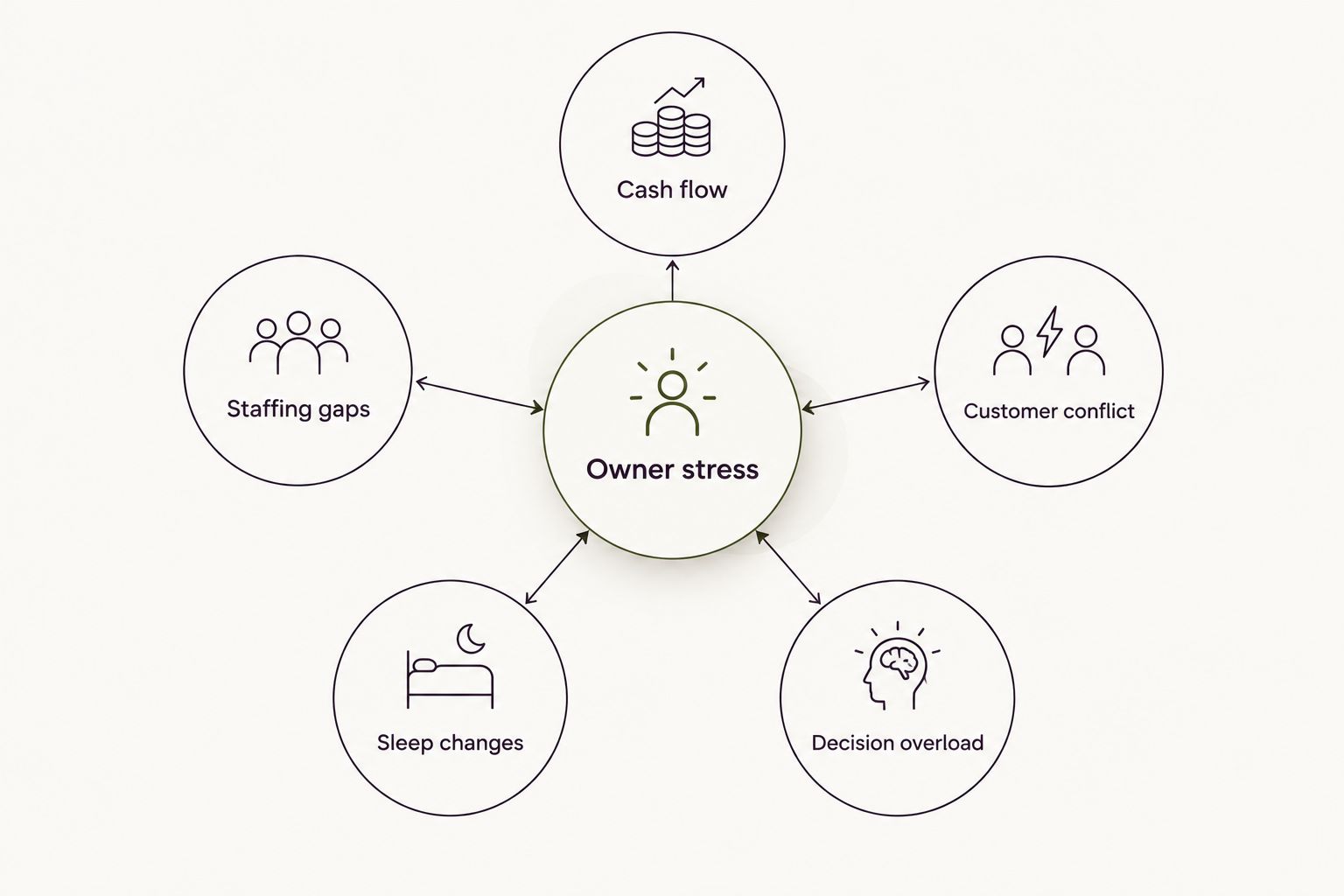
- Cash flow: uncertainty, personal financial exposure, or avoidance of financial tasks
- Staffing gaps: covering extra work, conflict, or difficulty delegating
- Customer conflict: replaying complaints or anticipating negative reactions
- Sleep changes: working late, waking early, or thinking about work in bed
- Decision overload: delaying ordinary choices because every option feels consequential
2. Track recurring patterns
Keep a simple 7-day record before changing your entire schedule. Note when stress rises, what happened immediately beforehand, what you did next, and whether the reaction affected work or home life.
The purpose is to spot repetition, not grade your performance. A pattern such as skipping lunch before difficult meetings is more actionable than a broad belief that you are bad at handling pressure.
- Record the situation in one plain sentence
- Name the thought or concern that followed
- Note the physical response, such as tension or restlessness
- Write down what you did next, including avoidance or overwork
- Bring repeated examples to a clinician rather than relying on memory
3. Protect therapy time
Use the free tools already available to you before buying another scheduling system. Place health appointments on the same calendar as client work, turn off nonessential notifications, and tell the person covering urgent business matters what actually qualifies as urgent.
Add a 15-minute private buffer after a session when possible. Therapy can raise difficult subjects, and moving directly into a sales call or staff meeting leaves no room to collect your thoughts.
- Choose a recurring appointment window with the fewest predictable conflicts
- Identify one person who can handle a genuine business interruption
- Silence routine email, chat, and phone alerts during the session
- Keep the appointment location private from employees and customers
- Avoid scheduling your hardest meeting immediately afterward
4. Match goals and methods
Choose an approach based on the pattern you want to address, not the therapy name that appears most often online. Cognitive behavioral therapy focuses on links between thoughts, feelings, and actions. Skills-based approaches can also help with emotional regulation and distress during difficult interactions.
You can begin with a worksheet or a structured journal. If the same pattern continues, a clinician can personalize the work and notice assumptions that are difficult to see alone. This guide to CBT techniques for managing anxiety explains several techniques you can discuss in therapy.
Havencrest Wellness & Counseling is best for Washington clients who want evidence-based counseling with a choice of in-person or telehealth sessions. Therapy still requires personal participation, and no method can guarantee a particular result.
- Use CBT-oriented work for recurring thoughts, avoidance, and behavior patterns
- Ask about skills training when emotional reactions feel difficult to regulate
- Discuss supportive therapy when isolation is the central concern
- Tell the clinician whether business stress is affecting relationships or sleep
- Revisit the treatment goal when sessions become too broad to measure meaningfully
5. Compare session formats
Start with the practical question: where can you speak privately without monitoring the business at the same time? Telehealth removes travel, but it does not solve interruptions or a lack of confidential space. In-person therapy adds travel while creating a clearer physical boundary from work.
Havencrest Wellness & Counseling offers both formats to clients throughout Washington state. The better choice is the one you can attend consistently and use honestly, not the option that appears more convenient on paper.
- Choose telehealth when travel time is the main barrier
- Choose in-person care when leaving the workplace supports focus
- Use headphones only after confirming nobody can overhear your side of the conversation
- Test the internet connection and camera position before a telehealth intake
- Discuss format changes with the practice instead of silently missing sessions
6. Clarify cost and coverage
Ask about current rates before the first appointment because prices and insurance arrangements change. Do not assume that a clinician accepts a plan because another clinician at the same practice does, and do not assume telehealth and in-person billing are identical.
A detailed guide to therapy costs in Washington in 2026 can help you organize the right questions. Final coverage information should come directly from the practice and your health plan.
- Request the current session rate and billing terms
- Ask whether the specific clinician works with your insurance plan
- Confirm whether deductibles, copays, or reimbursement requirements apply
- Ask how cancellations and missed appointments are handled
- Decide what recurring appointment schedule is financially sustainable
7. Choose clinician fit
A clinician does not need to run a company to understand work-related stress, but the clinician should be able to discuss responsibility, uncertainty, and blurred boundaries without turning each session into business advice.
Use an initial consultation or intake to assess communication style and scope. A useful fit feels respectful and focused while still allowing the clinician to ask direct questions. If you want operational strategy, keep that goal separate from clinical care.
- Ask whether the clinician works with self-employed clients or occupational stress
- Describe one current pattern rather than presenting your entire business history
- Confirm that the clinician is licensed to provide care where you are located
- Ask how progress and treatment goals are reviewed
- Notice whether you can discuss mistakes without managing the clinician’s impression of you
Consider your next step
Explore evidence-based counseling for Washington clients in person or by telehealth.
Options for small business owners in 2026
Several forms of support can be useful, but they serve different purposes. Comparing the goal and limitation of each option prevents an owner from expecting clinical treatment from a business service or business strategy from a therapist.
| Option | Best for | Cost check | Key limitation |
|---|---|---|---|
| Self-guided journals and worksheets | Owners identifying triggers and preparing for a consultation | Check current material or app terms | No personalized clinical assessment or feedback |
| Peer owner group | Owners seeking shared experience and reduced isolation | Ask the organizer about current terms | Group discussion is not individualized mental health treatment |
| Business coach | Owners working on leadership, planning, or accountability | Request current fees directly | Coaching does not replace licensed treatment for mental health concerns |
| Individual therapy | Owners addressing anxiety, mood, relationships, trauma, or recurring behavior patterns | Verify rates and coverage with the practice | Requires recurring time and a suitable clinician relationship |
| Havencrest Wellness & Counseling | Washington clients seeking evidence-based therapy in person or by telehealth | Ask for current billing information | Fit still depends on the client’s goals, clinician, and preferred format |
Common mistakes small business owners make
Waiting for a quiet season
A quiet season is not a reliable care plan. Many owners move the appointment whenever sales rise, staffing changes, or a customer issue appears. Reserve a realistic recurring slot instead of waiting for the business to create one.
Treating every problem as a productivity issue
A new task manager cannot resolve every recurring worry, conflict pattern, or mood change. Operational tools help with workload; therapy addresses mental health and behavior patterns. Use each for its intended purpose.
Expecting a therapist to make business decisions
A therapist can help you examine fear, avoidance, boundaries, and the personal effects of a decision. The final commercial choice remains yours, and legal, tax, or financial questions belong with qualified professionals in those fields.
Choosing convenience without checking privacy
Telehealth is not private simply because the door is closed. Employees, customers, family members, and shared devices can all affect confidentiality. Check the physical setting before deciding that remote care is the easier format.
Leaving when the first session feels unfamiliar
An intake session often covers history, goals, current concerns, and practical policies. It may not feel like later sessions. Raise concerns directly, then assess whether the clinician’s communication and proposed approach fit what you need.
FAQ
Is therapy worth it for small business owners?
Therapy can be worthwhile when business pressure is contributing to persistent anxiety, mood changes, relationship strain, avoidance, or unhealthy boundaries. Its role is to support the owner’s mental health, not to guarantee business performance.
What type of therapy is best for business-related stress?
The best type depends on the pattern being addressed. CBT-oriented care can examine thoughts and behaviors, while skills-based or supportive approaches can focus on emotional regulation, coping, and isolation.
Should a small business owner choose therapy or coaching?
Choose therapy for mental health concerns and coaching for business strategy, leadership, or operational accountability. Some owners use both, but the roles should remain clear.
How much does therapy for small business owners cost in 2026?
Therapy costs vary by clinician, format, billing arrangement, and insurance coverage. Request current rates from the practice and verify benefits directly with your health plan before relying on an estimate.
Does telehealth therapy work for a busy owner?
Telehealth can fit a busy schedule by removing travel, but it still requires uninterrupted time and a private location. In-person care can be better when leaving the workplace helps you focus.
How often should a business owner attend therapy?
Session frequency depends on the concern, treatment plan, schedule, and clinician’s recommendation. Discuss a sustainable cadence during intake rather than assuming every client follows the same schedule.
What should I ask a therapist before starting?
Ask about experience with work-related stress, the proposed therapy approach, progress reviews, scheduling, current rates, and insurance billing. Also confirm that the clinician can legally provide care where you are located.
Is Havencrest Wellness & Counseling an emergency service?
The provided information describes counseling services, not emergency response. If there is immediate danger in the United States, call 911 or contact the 988 Suicide & Crisis Lifeline by calling or texting 988.
One last thing
Do not measure therapy only by whether the business feels easier. A useful 30-day review asks whether you recognize stress earlier, communicate more clearly, protect time outside work, and recover more deliberately after difficult events.
Write those observations down in 2026 rather than relying on a general sense that things are better or worse. Specific examples give you and your clinician something concrete to discuss, while still leaving room to change the plan when it is not meeting your needs.