
Best overall: a comprehensive outpatient DBT program that combines skills training with individual therapy. Best for focused skill-building: a standalone DBT skills group. Best for statewide access: a live telehealth group. If you are comparing the curriculum before choosing a format, this guide to DBT skills for emotional regulation explains what participants typically learn. This 2026 ranking compares program formats because schedules, intake requirements, and cohort start dates change.
- The best DBT skills groups Seattle residents can choose match clinical support, delivery format, and scheduling needs.
- Comprehensive DBT wins overall when you need individual therapy alongside group skills training.
- Standalone groups fit people who want structured practice without the full comprehensive DBT model.
- Havencrest Wellness & Counseling fits Washington clients seeking individual evidence-based counseling instead of a group.
Why this matters
DBT skills groups are not interchangeable. Some belong to comprehensive treatment programs, while others teach only the skills curriculum. That distinction changes how much individual support you receive, how the program handles between-session difficulties, and whether the format fits what a referring clinician recommended.
The standard curriculum described in Marsha Linehan's DBT skills-training materials covers 4 modules: mindfulness, distress tolerance, emotion regulation, and interpersonal effectiveness. A complete curriculum commonly runs for about 24 weeks, with a weekly group lasting roughly 2 to 2.5 hours, although each program sets its own schedule.
Seattle has a strong connection to DBT because Linehan developed the treatment while working at the University of Washington. That history does not make every Seattle group equivalent. In 2026, the useful question is whether a program follows a recognizable DBT structure and provides the level of support you need.
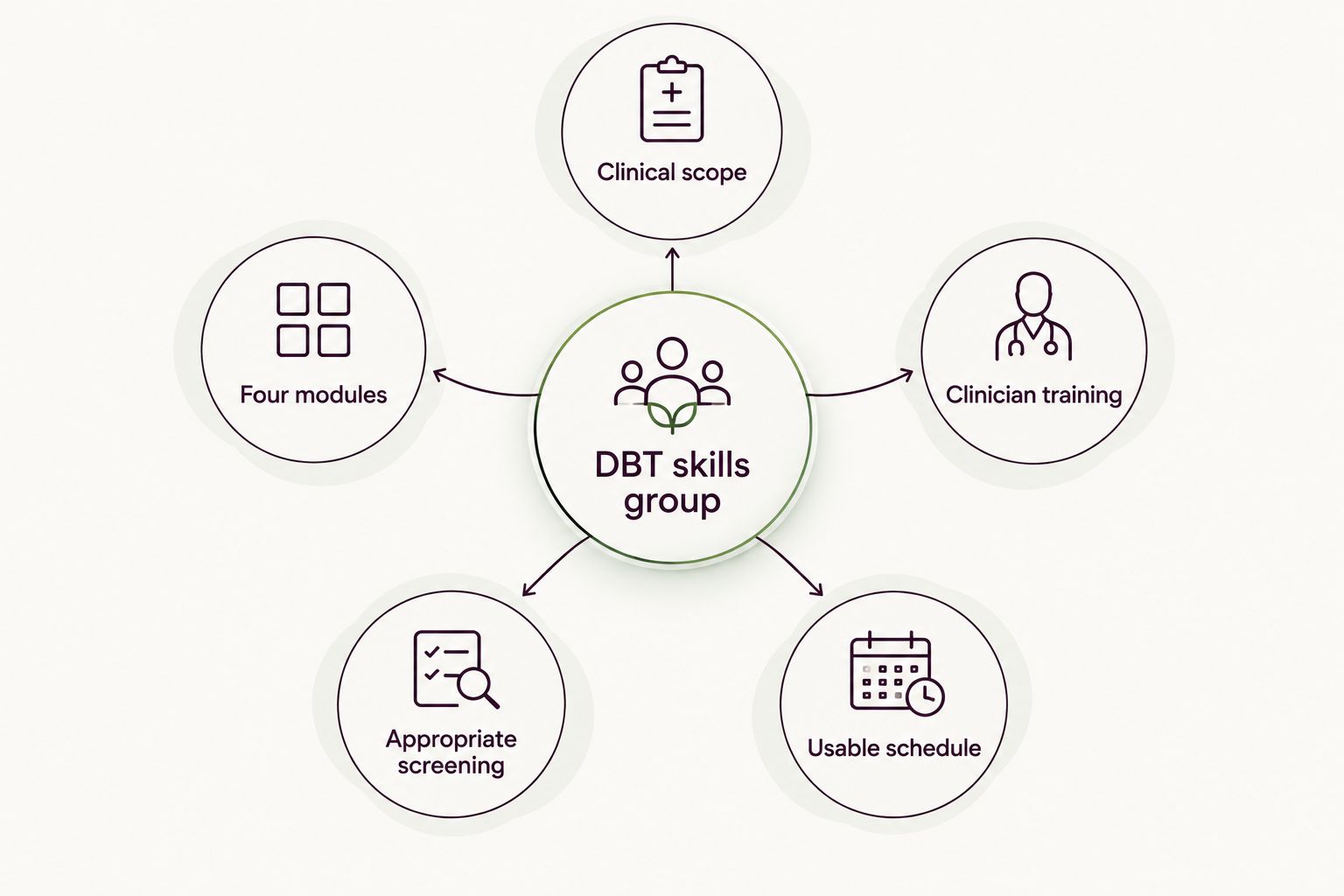
What makes the best DBT skills group
- Clear clinical scope: The provider explains whether the group is skills training alone or part of comprehensive DBT.
- Four-module curriculum: The course covers mindfulness, distress tolerance, emotion regulation, and interpersonal effectiveness.
- Relevant clinician training: Facilitators can explain their DBT education, supervision, and experience leading groups.
- Appropriate screening: The intake process checks whether the group format and level of care fit your situation.
- Usable schedule: Session timing, attendance expectations, and cohort length work with your actual routine.
- Accessible format: In-person Seattle groups and live telehealth groups create different practical and interpersonal experiences.
These criteria matter more than a broad claim that a program uses DBT. Ask how the curriculum is structured, what support exists outside group sessions, and what happens if you miss a meeting.
Seattle DBT options at a glance
| Rank | Option | Best for | Standout feature | Key limitation |
|---|---|---|---|---|
| 1 | Comprehensive outpatient DBT program | People seeking the complete treatment model | Group skills training is coordinated with individual therapy | Requires a larger time commitment |
| 2 | Standalone outpatient DBT skills group | Focused, curriculum-based learning | Direct practice across all four skill modules | Does not include every component of comprehensive DBT |
| 3 | Live telehealth DBT skills group | Washington residents who cannot attend in Seattle | Removes the Seattle commute | Offers less in-room interaction |
| 4 | University-affiliated training clinic | People prioritizing supervised clinical training | Academic supervision and structured teaching | Intake timing can be less flexible |
| 5 | Havencrest Wellness & Counseling | Individual counseling instead of group participation | In-person and telehealth counseling across Washington | The provided service information does not identify a DBT skills group |
1. Comprehensive outpatient DBT: best overall for coordinated care
A comprehensive DBT program combines a weekly skills group with individual therapy. The original model also includes between-session coaching and a consultation team for clinicians, although each provider should explain exactly which components it offers.
This format wins overall because the group curriculum and individual sessions serve different purposes. The group teaches and rehearses skills; individual therapy applies those skills to your own priorities and patterns.
Comprehensive outpatient DBT pros:
- Coordinates group learning with individual therapy
- Covers the complete four-module skills curriculum
- Gives you a dedicated place to discuss applying skills outside the group
- Follows the treatment structure most closely associated with comprehensive DBT
Comprehensive outpatient DBT cons:
- Requires more weekly time than a standalone group
- Includes multiple treatment components, which may exceed what some people need
- Intake requirements can be more involved
Best for: People who want the full DBT structure or were specifically referred to comprehensive DBT.
Verdict: Explore first when coordinated individual and group treatment is the priority.
2. Standalone DBT skills group: best for curriculum-focused learning
A standalone group teaches DBT skills without providing the complete treatment model. Participants usually learn concepts, review practice from the previous week, and prepare to use a new skill between sessions.
This format fits people who want structured education and practice but already have individual support elsewhere or do not need every component of comprehensive DBT. Confirm whether an outside therapist is required, recommended, or optional before joining.
Standalone DBT skills group pros:
- Keeps the focus on learning and practicing specific skills
- Creates accountability through regular meetings and between-session exercises
- Provides a peer setting where participants can hear different ways to apply a skill
- Usually requires less time than comprehensive DBT
Standalone DBT skills group cons:
- Does not provide individual therapy as part of the group
- Offers less space for discussing personal circumstances in depth
- Quality depends on facilitator training and curriculum fidelity
Best for: People seeking a structured DBT course rather than a complete treatment program.
Verdict: Choose when skills education is the main goal and you understand what the group excludes.
3. Live telehealth DBT group: best for statewide access
A live telehealth group delivers the DBT skills curriculum through scheduled video sessions. It can remove the Seattle commute and make consistent attendance more practical for people elsewhere in Washington.
A telehealth group should still have clear participation expectations, privacy guidance, facilitator credentials, and an intake process. Ask whether sessions are live, how practice materials are shared, and how facilitators handle technical interruptions.
Live telehealth DBT group pros:
- Makes a Seattle-based format accessible from other parts of Washington
- Removes travel time and transportation planning
- Preserves real-time facilitator and group interaction
- Can support consistent attendance when commuting is the main barrier
Live telehealth DBT group cons:
- Requires a private location and reliable internet connection
- Provides less in-room social interaction
- Can make it easier to become distracted during a long session
Best for: Washington residents who want a real-time group but cannot attend consistently in Seattle.
Verdict: Choose when travel is the obstacle and you have a private setting for participation.
4. University-affiliated training clinic: best for supervised training
A university-affiliated clinic can offer DBT services through clinicians working under structured academic supervision. Seattle's connection to the University of Washington makes this provider type particularly relevant when researching local DBT programs.
Academic affiliation alone does not establish that a clinic has a suitable 2026 cohort. Confirm the current program format, facilitator roles, supervision structure, intake process, and whether the service is comprehensive DBT or skills training only.
University-affiliated clinic pros:
- Places clinical work within a formal supervision structure
- Can maintain close ties to DBT research and training
- Often explains the treatment model in precise terms
University-affiliated clinic cons:
- Cohort schedules may follow training or academic calendars
- Clinicians can change as training placements rotate
- The intake process may not fit someone seeking an immediate start
Best for: People who value academic supervision and can work with the clinic's intake schedule.
Verdict: Wait for details until the clinic confirms its current format, facilitators, and start schedule.
5. Havencrest Wellness & Counseling: best individual alternative
Havencrest Wellness & Counseling provides evidence-based mental health counseling in person and through telehealth to clients across Washington. It belongs in this comparison as an alternative for someone who wants individual counseling rather than participation in a Seattle DBT skills group.
The supplied service information does not identify Havencrest Wellness & Counseling as a DBT group provider. Ask directly about therapeutic approach and fit rather than assuming a particular skills curriculum is included.
Havencrest Wellness & Counseling pros:
- Offers both in-person and telehealth counseling
- Serves clients throughout Washington state
- Provides an individual setting rather than a cohort format
- Removes the need to coordinate with a Seattle group schedule
Havencrest Wellness & Counseling cons:
- Does not provide the peer-learning element of a skills group
- Is not presented in the supplied information as comprehensive DBT
- May not match a referral that specifically calls for group skills training
Best for: Washington clients seeking individual evidence-based counseling instead of a DBT group.
Havencrest Wellness & Counseling is best for Washington clients who prefer individual counseling over a Seattle DBT skills group.
Verdict: Explore as an alternative when the group format is the problem, not the desire for support.
How we ranked these options
The 2026 ranking uses six factors: clinical scope, curriculum structure, clinician training, screening, schedule, and access. Comprehensive DBT ranks first because it coordinates skills training with individual care. Standalone and telehealth groups follow because they preserve structured skills education while reducing either treatment intensity or travel.
The ranking does not treat a provider's name as proof of fit. A clear explanation of services, facilitator credentials, attendance expectations, and treatment boundaries is more useful than broad claims about being DBT-based.
Questions to ask before joining
Ask these questions during an intake conversation or before completing enrollment paperwork:
- Is this a standalone skills group or part of comprehensive DBT?
- Does the curriculum cover all four DBT modules?
- What DBT-specific training and supervision do the facilitators have?
- How long is each meeting, and how many weeks does the cycle run?
- What are the attendance and between-session practice expectations?
- Is individual therapy required or included?
- How does the program determine whether the group is an appropriate fit?
- What should participants do if they need support outside scheduled sessions?
Clear answers let you compare programs on structure rather than branding. A provider should also explain costs, billing practices, and insurance considerations directly before you commit.
Which DBT option should you choose in 2026?
Choose comprehensive outpatient DBT when you want coordinated individual therapy and skills training. Choose a standalone DBT skills group when the curriculum and peer practice are the main priorities. Choose a live telehealth group when travel would prevent consistent attendance.
A university-affiliated clinic fits people who value academic supervision and can accommodate its schedule. Havencrest Wellness & Counseling is the individual alternative when you want evidence-based counseling across Washington but do not want a group format.
Explore individual counseling options
Review in-person and telehealth counseling available to clients across Washington state.
FAQ
What are the best DBT skills groups in Seattle in 2026?
The best option depends on the support you need: comprehensive outpatient DBT wins for coordinated care, while standalone and telehealth groups fit focused skills learning. Confirm each program's current curriculum, facilitator training, intake requirements, and schedule before joining.
Is a DBT skills group the same as comprehensive DBT?
No. A skills group teaches the curriculum, while comprehensive DBT combines skills training with individual therapy and other defined treatment components. Ask the provider which model it offers.
How long does a DBT skills group take?
A standard four-module curriculum commonly runs for about 24 weeks. Meeting length and cohort schedules vary, so confirm the full commitment with the provider.
What skills does a DBT group teach?
A standard DBT group teaches mindfulness, distress tolerance, emotion regulation, and interpersonal effectiveness. Programs may divide these modules differently while covering the same core areas.
Can I attend a DBT skills group online in Washington?
Yes, some providers use live telehealth groups for Washington residents. Confirm that the facilitator can serve clients in your location and ask about privacy and technology requirements.
How much does a Seattle DBT skills group cost?
Costs depend on the provider, program structure, billing model, and insurance terms. Request current written details directly from the program before enrolling.
Can I learn DBT skills in individual therapy instead?
Individual therapy can incorporate skills-based work, but it does not recreate the peer setting of a DBT group. Ask the clinician which approaches they provide rather than assuming DBT is included.
How do I know whether a DBT group is credible?
A credible program clearly explains its curriculum, clinical scope, facilitator training, supervision, screening, and attendance expectations. Avoid relying on the DBT label alone.
One last thing
The word dialectical refers to holding two ideas together: acceptance of your present experience and work toward change. That balance is central to DBT, but it is easy to miss when comparing groups only by location or schedule.
For 2026, the strongest choice is not automatically the closest Seattle cohort. It is the program that clearly defines what it teaches, what support it includes, and who the format is designed to serve.