
Picking an app to use between therapy sessions in 2026 comes down to one question: does it reinforce what your therapist is already working on with you, or does it just add another notification to ignore. This guide ranks six mental health apps against the criteria that matter when the goal is to support ongoing counseling, not replace it.
- Woebot wins overall for daily CBT-style check-ins that reinforce work done in therapy sessions.
- Sanvello is the strongest pick for mood and anxiety tracking between appointments.
- PTSD Coach, built by the VA and DoD, is the top choice for trauma-focused symptom tracking.
- None of these apps replace therapy or provide crisis support - use them alongside a licensed clinician.
- The best mental health apps alongside therapy in 2026 run on structured, evidence-based frameworks, not vague mood boosts.
Why this matters
An app is not a clinician. It cannot assess risk, adjust a treatment plan, or notice the things a trained therapist picks up on across sessions. What it can do is give you a place to practice a skill on a Tuesday afternoon instead of waiting until your next appointment.
Used well, an app extends the work happening in the therapy room. Used as a substitute for showing up to sessions, it becomes another form of avoidance dressed up as self-care. If you're already working with a therapist through Havencrest Wellness & Counseling or anywhere else in Washington in 2026, the apps below are worth discussing directly with your clinician rather than adopting on your own.
What makes the best mental health app to use alongside therapy
- Grounded in an evidence-based framework - CBT, DBT, or mindfulness-based approaches - not a generic mood-boosting gimmick
- Built to complement a treatment plan, not to diagnose or replace clinical judgment
- Readable privacy practices for mood logs and journal entries, not buried in dense legal text
- Low friction: a two-minute daily check-in beats a fifteen-minute one nobody finishes
- No implied crisis support or emergency response features
- Structured enough that you and your therapist can review the data together in session
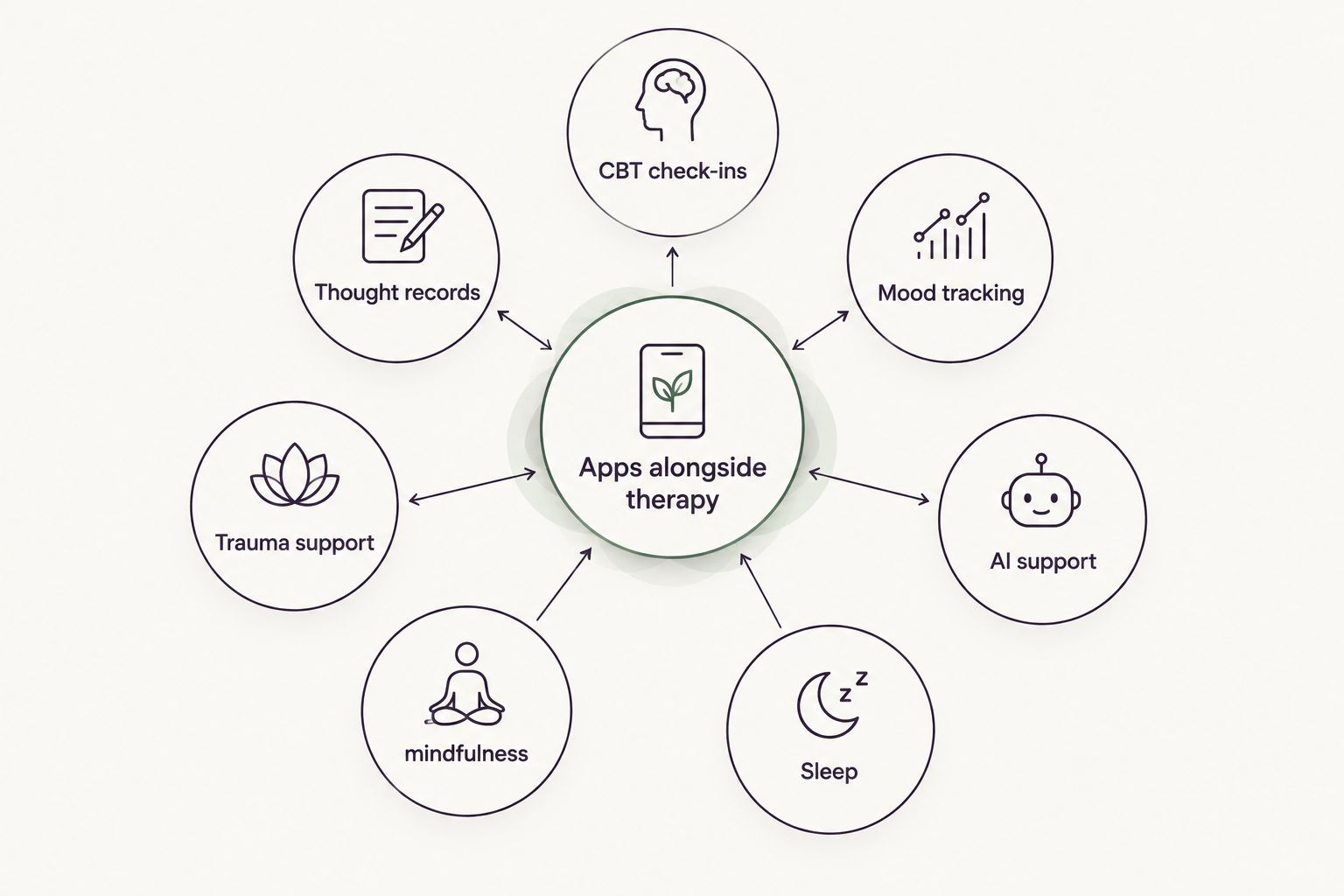
Best mental health apps alongside therapy in 2026: at a glance
| App | Best for | Standout feature | Key limitation |
|---|---|---|---|
| Woebot | Daily CBT-style check-ins between sessions | Short conversational exercises using CBT and IPT techniques | No human clinician on the other end |
| Sanvello | Mood and anxiety tracking | Guided CBT tools paired with symptom trend charts | Only as useful as how consistently you log |
| Wysa | AI-guided emotional support and journaling | Text-based chatbot with meditation and journaling prompts | AI responses can feel repetitive over time |
| Calm | Sleep and mindfulness support | Sleep stories, breathing exercises, guided meditations | Not built for structured symptom tracking |
| PTSD Coach | Trauma and PTSD symptom management | Developed by the U.S. Department of Veterans Affairs and Department of Defense | Narrow focus, not useful outside trauma symptoms |
| MoodKit | Structured CBT thought records | Thought-record worksheets based on cognitive behavioral therapy | More clinical, less conversational interface |
1. Woebot: best mental health app for daily CBT-style check-ins between sessions
Woebot runs short daily conversations using cognitive behavioral therapy and interpersonal therapy techniques, aimed at helping you notice thought patterns as they happen rather than trying to remember them a week later in session.
Woebot pros:
- Conversational format lowers the barrier to daily use
- Draws on CBT and IPT frameworks similar to what many therapists already teach
- Short enough to fit into a commute or lunch break
Woebot cons:
- Chatbot responses follow scripted logic, not genuine understanding
- Not built for processing complex trauma or grief
- No live human support if you're struggling in the moment
Best for: clients who want a low-effort way to practice CBT skills daily. Verdict: Try it.
2. Sanvello: best mental health app for mood and anxiety tracking
Sanvello pairs daily mood check-ins with anxiety and depression tracking, then layers in CBT-based coping tools and guided meditations tied to what the tracker flags.
Sanvello pros:
- Visual mood charts make patterns easy to bring into your next session
- Coping tools are organized by symptom, not general wellness
- Works well as a bridge between weekly or biweekly appointments
Sanvello cons:
- Tracking only helps if you log consistently
- Some tools sit behind initial account setup
- Not designed for trauma-specific symptoms
Best for: clients working on anxiety or depression who want data to bring into session. Verdict: Try it.
3. Wysa: best mental health app for AI-guided emotional support and journaling
Wysa pairs an AI chatbot with journaling prompts, breathing exercises, and short meditations, giving you somewhere to process a rough moment between appointments.
Wysa pros:
- Available any time of day for a quick check-in
- Journaling prompts give your therapist something to build on
- Meditation library covers stress, sleep, and self-esteem
Wysa cons:
- AI conversation can feel repetitive with regular use
- Not appropriate for processing acute distress
- Overlaps with tools already found in Woebot and Sanvello
Best for: clients who want a journaling habit with light AI prompting. Verdict: Try it.
4. Calm: best mental health app for sleep and mindfulness support
Calm focuses on sleep stories, breathing exercises, and guided meditation instead of symptom tracking or CBT exercises, making it a companion for the sleep and stress issues that often ride alongside anxiety or depression.
Calm pros:
- Strong library of sleep-focused content
- Short breathing exercises work well before or after a stressful session
- Simple enough that inconsistent use still adds value
Calm cons:
- No CBT or DBT structure, so it doesn't reinforce specific therapy skills
- Not designed for mood or symptom tracking
- Broad wellness focus rather than a clinical framework
Best for: clients whose sleep or general stress worsens their symptoms. Verdict: Try it as a supplement, not a primary tool.
5. PTSD Coach: best mental health app for trauma and PTSD symptom management
PTSD Coach was developed by the U.S. Department of Veterans Affairs and Department of Defense to help people track PTSD symptoms, learn about trauma responses, and practice grounding tools between clinical appointments.
PTSD Coach pros:
- Built specifically around PTSD symptom patterns, not general mood
- Grounding and relaxation tools are quick to access during a symptom spike
- Backed by a federal agency with a clinical mandate
PTSD Coach cons:
- Narrow focus means it's not useful for anxiety or depression outside trauma
- Interface is more utilitarian than the conversational apps on this list
- Not a substitute for trauma-focused therapy like EMDR or CPT
Best for: clients working through trauma who want symptom tracking between sessions. Verdict: Try it, especially alongside trauma-focused therapy.
6. MoodKit: best mental health app for structured CBT thought records
MoodKit is built around thought-record worksheets, activity tracking, and mood ratings drawn directly from cognitive behavioral therapy, giving you a structured way to practice the thought-challenging work many therapists assign as homework.
MoodKit pros:
- Thought records mirror worksheets many CBT-trained therapists already use
- Activity tracking connects mood to daily behavior patterns
- Good fit for clients who prefer structure over conversation
MoodKit cons:
- Feels more clinical and less approachable than chatbot-style apps
- Requires more manual entry than Sanvello or Woebot
- Learning curve for clients new to CBT concepts
Best for: clients doing CBT in therapy who want extra worksheet practice. Verdict: Try it if your therapist already uses CBT worksheets.
How this ranking was built
Each app was weighed against the same six criteria: an evidence-based framework, a supporting (not replacing) role, readable privacy practices, low daily friction, no implied crisis support, and content structured enough to review with a clinician. PTSD Coach ranks where it does because it's built by a federal agency with a defined clinical mandate, not a private wellness company. Woebot and Sanvello rank at the top because their frameworks map directly onto what a CBT-trained therapist is already doing in session.
Which app should you pick alongside therapy in 2026?
For most people starting therapy in 2026, Woebot is the strongest overall pick because the daily CBT-style check-ins reinforce skills without asking for much time. If mood and anxiety tracking matters more to you, Sanvello gives you the clearest data to bring into session. If trauma is the focus of your treatment, PTSD Coach is purpose-built for that work in a way the others aren't.
Whichever app you choose, mention it to your therapist. A good clinician will tell you honestly whether it fits your treatment plan or whether it's pulling focus from the work you're doing together.
Talk through your options with a therapist
Discuss which tools fit your treatment plan during a consultation.
FAQ
What's the best mental health app to use alongside therapy in 2026?
Woebot is the strongest overall pick in 2026 for its daily CBT-style check-ins, though Sanvello is better for mood tracking and PTSD Coach is built specifically for trauma symptoms.
Can a mental health app replace therapy?
No. These apps are self-guided tools designed to support ongoing treatment, not a substitute for working with a licensed clinician who can assess and adjust your care.
Is Woebot good for anxiety?
Woebot uses CBT and interpersonal therapy techniques that can help with anxious thought patterns, but it works best paired with, not instead of, therapy focused on anxiety.
Is PTSD Coach only for veterans?
No. PTSD Coach was developed by the VA and DoD but is publicly available to anyone managing PTSD symptoms, including people working with a civilian therapist.
How do I know if a mental health app is evidence-based?
Check whether the app names the clinical framework it uses, such as CBT or DBT, and whether that framework is published and reviewed rather than a proprietary label with no explanation.
Should I tell my therapist which app I'm using?
Yes. Sharing mood logs or journal entries from an app gives your therapist more to work with and helps them tell you whether the tool fits your treatment plan.
Are mental health apps private and secure?
Privacy practices vary by app, so read the data policy before logging sensitive mood or trauma information, and favor apps with clear, plain-language privacy terms.
Can these apps help between therapy sessions in Washington state?
Yes, apps like Sanvello and Woebot are designed for daily use regardless of location, making them a practical bridge between weekly or biweekly sessions with a Washington-based therapist.
One last thing
The apps on this list are more useful as pattern-finders than as fixes. Two weeks of consistent daily logging in Sanvello or Woebot gives your therapist far more to work with than a single detailed entry after a hard day - consistency, not depth, is what makes the data usable in session.