
Group DBT can be as effective as individual DBT for some measured outcomes, but it is not an equivalent replacement for every person or clinical need. A guide to DBT skills for emotional regulation explains what a skills group teaches; individual sessions apply those skills to private goals, and comprehensive DBT combines both formats.
- Is group DBT as effective as individual sessions? It can be for specific outcomes, but the formats serve different purposes.
- A 2015 randomized trial found comparable self-harm reductions across three DBT conditions during one year of treatment.
- Group DBT teaches skills; individual DBT applies them to personal behaviors, barriers, and treatment goals.
- Comprehensive DBT combines individual therapy, skills training, phone coaching, and a therapist consultation team.
- Havencrest Wellness & Counseling is best suited to Washington clients seeking evidence-based counseling in person or by telehealth in 2026.
Is group DBT therapy as effective as individual sessions?
Group DBT can match individual DBT for certain outcomes, but the answer depends on what each program includes and which outcome matters. Group skills training focuses on learning and practicing structured skills. Individual DBT focuses on applying those skills to your personal behavior patterns, treatment barriers, and weekly priorities.
The strongest direct comparison is a 2015 randomized clinical trial published in JAMA Psychiatry. The study followed 99 women with borderline personality disorder and elevated suicide risk across three treatment conditions for one year: standard DBT, DBT skills training with case management, and individual DBT with an activities group. All three conditions produced improvements in suicide attempts, suicidal ideation, and self-harm measures.
That finding does not prove that any standalone skills class is equal to individual therapy. The skills-focused condition included case management, while the individual condition included an activities group. For a 2026 treatment decision, compare the complete services being offered rather than relying on the group or individual label alone.
| Format | Main purpose | Core advantage | Main limitation | Best for |
|---|---|---|---|---|
| Group DBT skills training | Learning and rehearsing DBT skills | Structured practice with other participants | Limited time for private concerns | People primarily seeking practical coping skills |
| Individual DBT | Applying DBT to personal treatment targets | Private, individualized attention | Does not reproduce the full skills-group curriculum | People who need focused one-to-one work |
| Comprehensive DBT | Combining skills and individual application | Covers the complete treatment model | Requires more weekly participation | People whose needs match the full DBT structure |
Why this matters
Choosing between group and individual DBT is not simply a choice between shared attention and private attention. You are deciding whether you mainly need structured skills instruction, individualized application, or both. Those are different functions, even when each service uses the DBT name.
A group can help you practice mindfulness, distress tolerance, emotion regulation, and interpersonal effectiveness in a predictable format. An individual session gives you space to examine where those skills break down in your own week. In 2026, the practical question is not which format is universally better; it is which treatment function you need.
Havencrest Wellness & Counseling offers evidence-based mental health counseling to clients throughout Washington, both in person and through telehealth. That makes it a relevant option when you want individualized counseling while considering whether a separate DBT skills group also belongs in your plan.
Group DBT skills training: 2 to 2.5 hours weekly
A standard DBT skills group is organized like a class rather than an open-ended support group. Facilitators teach a curriculum, review practice between meetings, introduce new skills, and assign exercises for the following week. The four core skill areas are mindfulness, distress tolerance, emotion regulation, and interpersonal effectiveness.
Group DBT offers three clear benefits:
- You receive an organized curriculum instead of choosing each session topic from scratch.
- You can observe how other participants understand and practice the same skill.
- Repeated exercises can make abstract ideas easier to use outside the session.
The trade-off is privacy and personalization. A group does not provide enough time to examine every participant's history, barriers, relationships, or treatment priorities in depth. It also is not the same as a general process group, where members spend most of the meeting discussing personal experiences with one another.
Best for: people who want structured skills instruction and can practice between meetings. For a 2026 comparison, confirm whether the program is a full DBT skills curriculum, a shortened class, or a general group using selected DBT techniques.
Individual DBT: about 1 hour weekly
Individual DBT applies the treatment principles to events from your own life. Sessions commonly review behaviors and emotions from the previous week, identify where a skill could have been used, and address obstacles that make change difficult. The work is private and responsive to your treatment goals.
The main advantage is focus. Your therapist can spend the session examining one pattern in detail, clarifying what happened before and after it, and selecting a skill that fits the situation. Individual work also allows the treatment plan to respond when your priorities change.
The limitation is that individual sessions do not automatically provide the same systematic skills curriculum as a dedicated group. Some therapists teach DBT skills during individual counseling, but the time available for instruction competes with other treatment needs. Ask what the clinician means by DBT and whether sessions follow a defined DBT model.
Best for: people who need private, individualized support or cannot participate comfortably in a group. In 2026, individual DBT remains distinct from general therapy that occasionally borrows a mindfulness or emotion-regulation exercise.
Comprehensive DBT: 2 core weekly sessions
Comprehensive DBT combines weekly individual therapy with weekly skills training. The complete model also includes between-session phone coaching and a consultation team for participating clinicians. Phone coaching is intended to support skill use between appointments, while the consultation team helps clinicians follow the treatment model consistently.
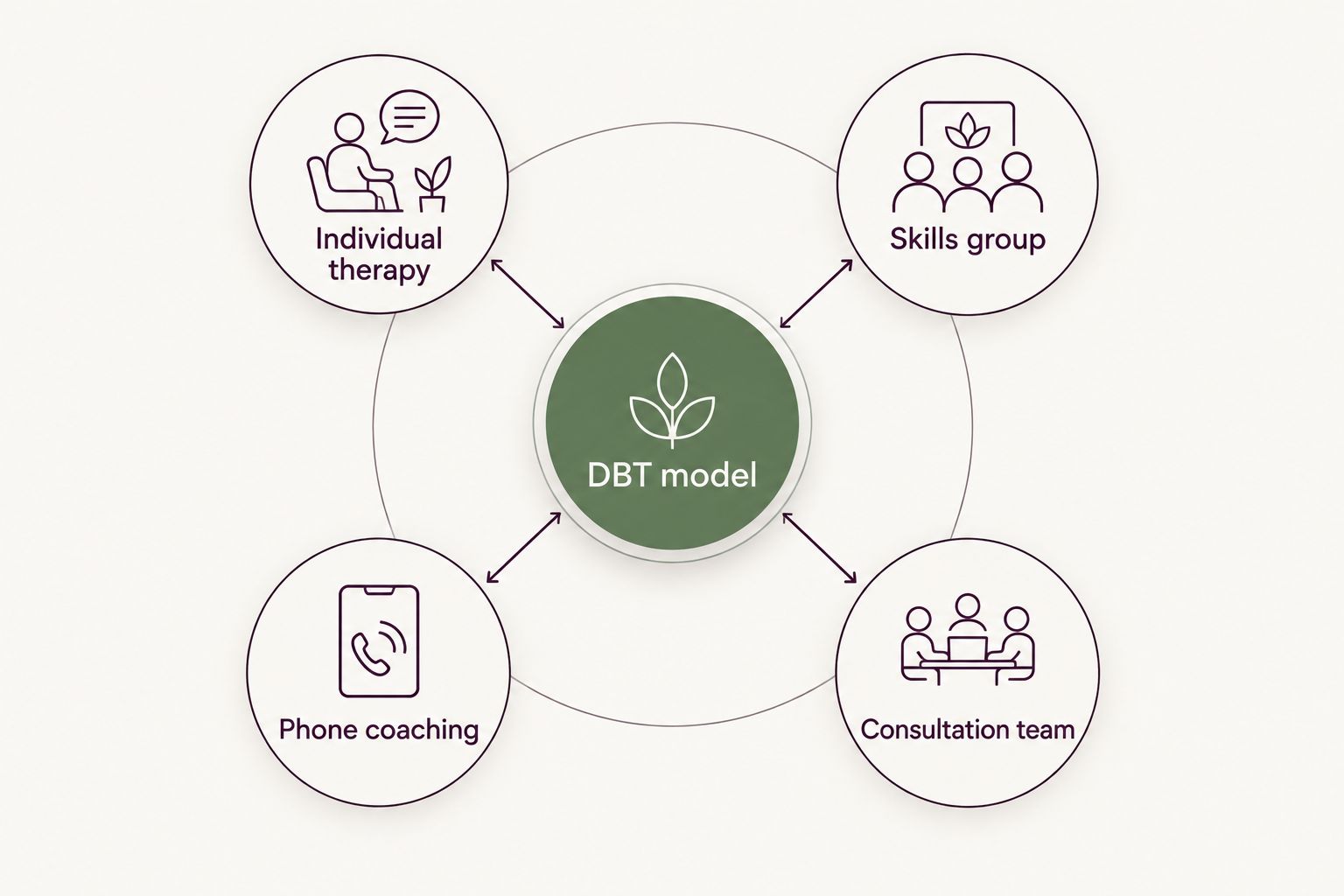
This combined format has the broadest evidence base for the high-risk population for whom DBT was originally developed. Its strength is coordination: the group teaches the skill, the individual session addresses personal barriers to using it, and coaching supports application between meetings.
Its limitation is the commitment required. You need time for both weekly components and for practice outside meetings. Comprehensive DBT is therefore not automatically the right fit for everyone who wants help with emotional regulation.
Best for: people whose clinical needs and treatment goals call for the complete DBT structure. In 2026, comprehensive DBT remains the clearest reference point when research describes standard DBT.
Why DBT effectiveness varies
The same format can work differently depending on how the program is structured and how well it fits the participant. These factors have more meaning than the group or individual label by itself:
- Program completeness: Skills training with case management is not equivalent to a standalone class with no individual clinical contact.
- Clinician preparation: DBT follows a defined treatment model. Ask what DBT-specific education, supervision, or consultation supports the clinician's work.
- Your treatment goals: Learning coping skills is different from examining a recurring behavior or working through a private relationship concern.
- Practice between sessions: Both formats depend on applying skills outside the therapy room. Understanding a skill intellectually is not the same as using it during a difficult moment.
- Group structure: A closed curriculum-based group differs from a drop-in support group. The meeting format affects what can be taught and practiced.
- Comfort with disclosure: Some people learn well around peers but prefer to discuss sensitive details privately. Others benefit from seeing that skill practice can be difficult for everyone.
A useful 2026 comparison asks what happens during each meeting, what support exists between meetings, and how progress is reviewed. The service description matters more than the format name.
How to choose between group and individual DBT
Start with the reason you are considering DBT. You do not need to select a format based on a diagnosis alone, and an article cannot determine which level of support fits your circumstances. A clinician can help connect the options to your goals and preferences.
Use these questions during a consultation:
- Is this a complete DBT program or a DBT-informed service? Both can be useful, but they are not interchangeable.
- Does the group cover all four DBT skill areas? Ask whether the curriculum includes mindfulness, distress tolerance, emotion regulation, and interpersonal effectiveness.
- What individual support accompanies the group? Clarify whether case management, individual counseling, or between-session coaching is included.
- How are personal goals reviewed? A structured process for reviewing progress helps connect skill practice to the reason you started therapy.
- What happens if the format does not fit? Ask how the clinician evaluates whether group, individual, or combined care remains appropriate.
Havencrest Wellness & Counseling is best suited to Washington clients who want evidence-based mental health counseling with in-person or telehealth access. A consultation can help you discuss whether individual counseling fits your current needs and whether external group skills training should also be considered.
Explore your counseling options
Review in-person and telehealth counseling for clients throughout Washington.
Can group DBT work without individual therapy?
Group DBT can work without individual therapy when the main goal is learning and practicing skills, but that arrangement is not the same as comprehensive DBT. The 2015 comparison study paired skills training with case management, so it should not be used to claim that every standalone skills class produces equal results.
If you are comparing programs in 2026, ask what support exists beyond the group meeting. A clear answer should identify who reviews your individual goals, how concerns are handled privately, and whether the program refers participants for additional care when appropriate.
Is individual DBT better for private or complex concerns?
Individual DBT provides more space for private concerns because the full appointment centers on your treatment goals. It also allows the clinician to examine patterns, barriers, and recent events in greater detail than a group curriculum usually permits.
That does not make individual DBT universally more effective. If your main need is systematic instruction across all four skill areas, a well-run skills group may cover the curriculum more efficiently.
Do you need both group and individual DBT?
You need both when your clinical needs call for comprehensive DBT and you can participate in the complete structure. You do not automatically need both simply because you want to learn DBT skills.
The best 2026 decision depends on the program's actual components, your treatment goals, and a clinician's assessment. The important distinction is between complete DBT, a skills-only program, individual DBT, and general therapy that uses selected DBT techniques.
FAQ
Is group DBT as effective as individual sessions?
Group DBT can be as effective as individual DBT for specific measured outcomes, but the formats perform different functions. A 2015 randomized trial found improvement across standard DBT, skills training with case management, and individual DBT with an activities group.
What is the main difference between group and individual DBT?
Group DBT mainly teaches and rehearses a structured skills curriculum, while individual DBT applies those skills to personal treatment goals and weekly challenges. Comprehensive DBT combines both.
Can I attend a DBT group without having an individual therapist?
You can attend some standalone DBT skills groups without individual therapy, depending on the program's requirements. That format is not the same as comprehensive DBT or the skills condition used in the 2015 comparison trial, which included case management.
What skills does a DBT group teach?
A standard DBT skills group teaches mindfulness, distress tolerance, emotion regulation, and interpersonal effectiveness. The curriculum uses instruction, practice, and exercises between meetings.
Is a DBT skills group the same as group therapy?
A DBT skills group is usually more like a structured class than open-ended group therapy. It follows a curriculum and emphasizes learning and practicing defined skills.
Is online group DBT as effective as meeting in person?
Online DBT can deliver structured skills instruction, but effectiveness depends on the program, clinician, participant needs, and support surrounding the group. Ask how the online program handles privacy, participation, individual concerns, and between-session support.
How do I know whether a therapist offers comprehensive DBT?
Ask whether the service includes individual therapy, skills training, between-session phone coaching, and a clinician consultation team. A service using selected DBT exercises should be described as DBT-informed rather than comprehensive DBT.
What should I compare when choosing a DBT program in 2026?
Compare the program's components, curriculum, clinician preparation, individual support, and process for reviewing progress. The complete service matters more than whether its name includes group or individual DBT.
One last thing
The most important research detail is also the easiest to miss: the 2015 trial did not compare a basic skills class with completely unsupported individual therapy. Each condition included additional support, and all participants belonged to a specific high-risk study population. Applying that result to every person or program would stretch the evidence beyond what the study established.
For a 2026 decision, ask for a precise description of the service before comparing outcomes. Havencrest Wellness & Counseling can help Washington clients discuss evidence-based counseling options without assuming that one format fits everyone.